USB Device Stack
Overview
The ESP-IDF USB Device Stack (hereinafter referred to as the Device Stack) enables USB Device support on ESP32-P4. By using the Device Stack, ESP32-P4 can be programmed with any well defined USB device functions (e.g., keyboard, mouse, camera), a custom function (aka vendor-specific class), or a combination of those functions (aka a composite device).
The Device Stack is built around the TinyUSB stack, but extends TinyUSB with some minor features and modifications for better integration with ESP-IDF. The Device stack is distributed as a managed component via the ESP Component Registry.
Features
- 1 USB High-Speed (USB 2.0) peripheral with internal PHY
Endpoint 0 and 15 additional endpoints configurable as IN or OUT
Up to 8 IN endpoints (including Endpoint 0) concurrently active.
- 1 USB Full-Speed (USB 1.1) peripheral with internal PHY
Endpoint 0 and 6 additional endpoints configurable as IN or OUT
Up to 5 IN endpoints (including Endpoint 0) concurrently active.
Multiple supported device classes (CDC, HID, MIDI, MSC…)
Vendor specific class
Composite devices
VBUS monitoring for self-powered devices
Remote wakeup
Automatic light sleep control via ESP-IDF PM locks
Light sleep wakeup on USB activity while suspended (high-speed ports only)
Hardware Connection
The ESP32-P4 routes the USB 2.0 peripheral D+ and D- signals to their dedicated pins. For USB device functionality, these pins must be connected to the bus (e.g., via a Micro-B port, USB-C port, or directly to standard-A plug).
The ESP32-P4 routes the USB 1.1 peripheral D+ and D- signals to GPIOs 27 and 26 respectively. For USB device functionality, these GPIOs must be connected to the bus (e.g., via a Micro-B port, USB-C port, or directly to standard-A plug).
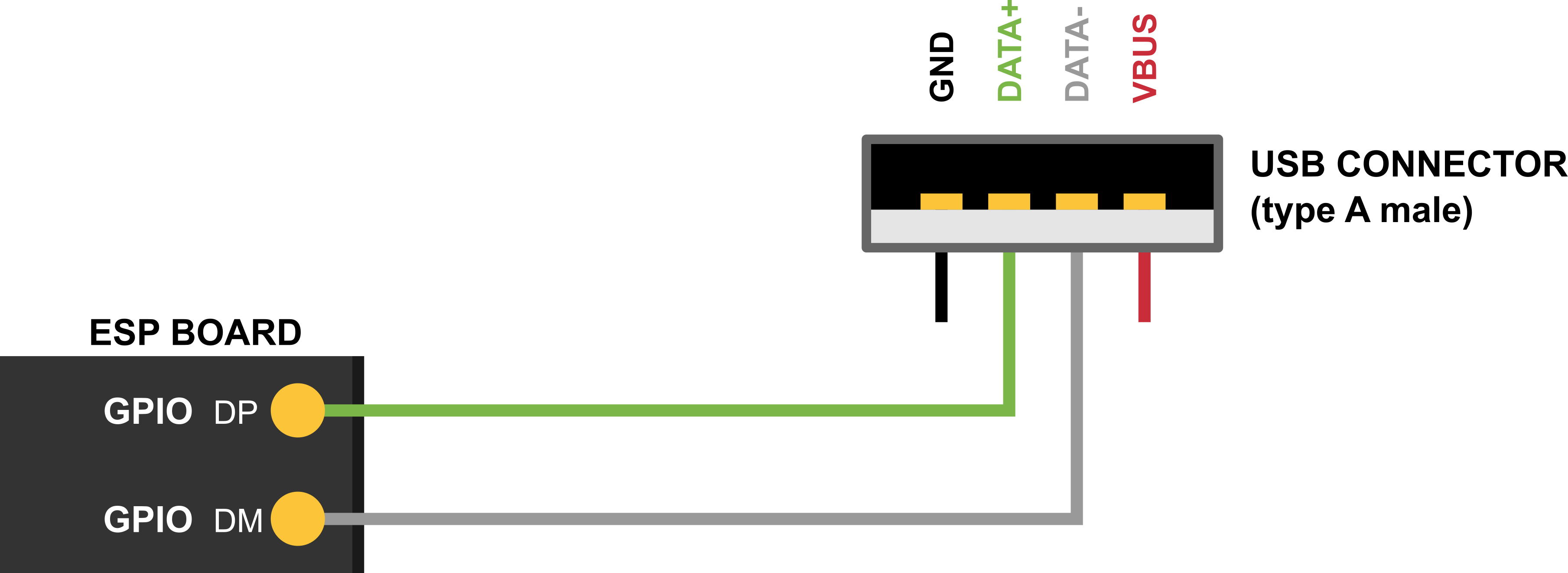
Note
Self-powered devices must also connect VBUS through a voltage divider or comparator. For more details, please refer to Self-Powered Device.
Device Stack Structure
The basis of the Device Stack is TinyUSB, where the Device Stack implements the following features on top of TinyUSB:
Customization of USB descriptors
Serial device support
Redirecting of standard streams through the Serial device
Storage Media (SPI-Flash and SD-Card) for USB Device MSC Class.
A task within the encapsulated device stack that handles TinyUSB servicing
Component Dependency
The Device Stack is distributed via the ESP Component Registry. Thus, to use it, please add the Device Stack component as dependency using the following command:
idf.py add-dependency esp_tinyusb
Configuration Options
Multiple aspects of the Device Stack can be configured using menuconfig. These include:
The verbosity of the TinyUSB’s log
Device Stack task related options
Default device/string descriptor options
Class specific options
Power management options (PM locks and USB wakeup)
The generated Kconfig reference for the available CONFIG_TINYUSB_* options is provided at the end of this document.
Descriptor Configuration
The tinyusb_config_t structure exposes USB descriptor settings through tinyusb_config_t::descriptor, which is a tinyusb_desc_config_t.
The following descriptors should be initialized for both full-speed and high-speed devices:
Full-speed devices should initialize the following field to provide their configuration descriptor:
High-speed devices should initialize the following fields to provide configuration descriptors at each speed:
Note
Both tinyusb_desc_config_t::full_speed_config and tinyusb_desc_config_t::high_speed_config must be present to comply with the USB 2.0 specification.
The Device Stack will instantiate a USB device based on the descriptors provided in the fields described above when tinyusb_driver_install() is called.
The Device Stack also provides default descriptors when the corresponding fields in tinyusb_desc_config_t are set to NULL. Their values come from menuconfig options such as CONFIG_TINYUSB_DESC_*. Default descriptors include:
Default device descriptor: set
tinyusb_desc_config_t::devicetoNULL.Default string descriptor: set
tinyusb_desc_config_t::stringtoNULL.Default qualifier descriptor: set
tinyusb_desc_config_t::qualifiertoNULLon high-speed-capable devices.Default configuration descriptors. Some classes that rarely require custom configuration (such as CDC, MSC, and NCM) provide default configuration descriptors. These can be enabled by setting the associated field to
NULL:tinyusb_desc_config_t::full_speed_config: full-speed descriptortinyusb_desc_config_t::high_speed_config: high-speed descriptor on high-speed-capable devices
Installation
To install the Device Stack, please call tinyusb_driver_install(). The Device Stack’s configuration is specified in a tinyusb_config_t structure that is passed as an argument to tinyusb_driver_install().
Note
Initialize tinyusb_config_t with TINYUSB_DEFAULT_CONFIG() and then override only the fields you need. Descriptor pointers left as NULL use the default descriptor values when available.
#include "tinyusb_default_config.h"

tinyusb_config_t tusb_cfg = TINYUSB_DEFAULT_CONFIG();
tusb_cfg.descriptor.device = NULL;
tusb_cfg.descriptor.string = NULL;
tusb_cfg.descriptor.full_speed_config = NULL;
#if (SOC_USB_OTG_PERIPH_NUM > 1)
    tusb_cfg.descriptor.high_speed_config = NULL;
    tusb_cfg.descriptor.qualifier = NULL;
#endif

ESP_ERROR_CHECK(tinyusb_driver_install(&tusb_cfg));
Self-Powered Device
USB specification mandates self-powered devices to monitor voltage levels on USB’s VBUS signal. As opposed to bus-powered devices, a self-powered device can be fully functional even without a USB connection. The self-powered device detects connection and disconnection events by monitoring the VBUS voltage level. VBUS is considered valid if it rises above 4.75 V and invalid if it falls below 4.35 V.
On the ESP32-P4, this will require using a GPIO to act as a voltage sensing pin to detect when VBUS goes above/below the prescribed thresholds. However, ESP32-P4 pins are 3.3 V tolerant. Thus, even if VBUS rises/falls above/below the thresholds mentioned above, it would still appear as a logic HIGH to the ESP32-P4. Thus, in order to detect the VBUS valid condition, users can do one of the following:
Connect VBUS to a voltage comparator chip/circuit that detects the thresholds described above (i.e., 4.35 V and 4.75 V), and outputs a 3.3 V logic level to the ESP32-P4 indicating whether VBUS is valid or not.
Use a resistor voltage divider that outputs (0.75 x Vdd) if VBUS is 4.4 V (see figure below).
Note
In either case, the voltage on the sensing pin must be logic low within 3 ms after the device is unplugged from the USB host.

Simple voltage divider for VBUS monitoring
To use this feature, set tinyusb_phy_config_t::self_powered to true and tinyusb_phy_config_t::vbus_monitor_io to the GPIO used for VBUS monitoring through tinyusb_config_t::phy.
Power Management
Suspend and Resume Events
Suspend and resume device events are optional and disabled by default. Enable the following Kconfig options to receive them through the USB Device Event callback (tinyusb_config_t::event_cb):
CONFIG_TINYUSB_SUSPEND_CALLBACK enables
TINYUSB_EVENT_SUSPENDEDCONFIG_TINYUSB_RESUME_CALLBACK enables
TINYUSB_EVENT_RESUMED
When these options are enabled, esp_tinyusb provides strong implementations of tud_suspend_cb() and tud_resume_cb(). User applications must not define these callbacks themselves, or a linker error will occur due to multiple definitions.
If the Kconfig options are disabled, users may implement tud_suspend_cb() and tud_resume_cb() directly in the application instead.
Remote Wakeup
When the host suspends the device and enables remote wakeup, the device can signal resume with tinyusb_remote_wakeup(). Call this function only while the device is suspended and the host has enabled remote wakeup for the current suspend cycle.
Automatic Light Sleep via PM Locks
esp_tinyusb can manage an esp_pm_lock_type_t::ESP_PM_NO_LIGHT_SLEEP lock based on USB device state. While the lock is held, the SoC will not enter automatic light sleep. When the USB host suspends the bus, esp_tinyusb releases the lock so automatic light sleep can proceed.
Enable this feature in two steps, using Kconfig options and runtime settings:
Kconfig prerequisites
Enable CONFIG_TINYUSB_PM in menuconfig. This option requires the following config options:
Runtime settings
configure the ESP-IDF PM module with the
esp_pm_config_t::light_sleep_enableset totrue,set
tinyusb_config_t::pm_lock_enabletotruewhen callingtinyusb_driver_install().
Configure automatic light sleep through ESP-IDF PM:
esp_pm_config_t pm_config = {
    .max_freq_mhz = CONFIG_ESP_DEFAULT_CPU_FREQ_MHZ,
    .min_freq_mhz = CONFIG_ESP_DEFAULT_CPU_FREQ_MHZ,
    .light_sleep_enable = true,
};
ESP_ERROR_CHECK(esp_pm_configure(&pm_config));

tinyusb_config_t tusb_cfg = TINYUSB_DEFAULT_CONFIG();
tusb_cfg.pm_lock_enable = true;
ESP_ERROR_CHECK(tinyusb_driver_install(&tusb_cfg));
Lock behavior
On driver install, esp_tinyusb creates an
esp_pm_lock_type_t::ESP_PM_NO_LIGHT_SLEEPlock and acquires it.On
TINYUSB_EVENT_ATTACHED, the lock is acquired if it is not already held.On
TINYUSB_EVENT_SUSPENDED, the lock is released while the device remains mounted, allowing automatic light sleep.On
TINYUSB_EVENT_RESUMED, the lock is re-acquired.On
TINYUSB_EVENT_DETACHED, the lock is acquired and the suspend PM state is cleared.tinyusb_remote_wakeup()acquires the lock before signaling remote wakeup to the host.
Suspend and Resume callbacks CONFIG_TINYUSB_SUSPEND_CALLBACK and CONFIG_TINYUSB_RESUME_CALLBACK must be enabled, registered inside the esp_tinyusb, otherwise the PM module would not have information about the device being suspended or resumed.
Use tinyusb_pm_get_lock_status() to query whether the PM lock is currently held.
On high-speed supported targets with CONFIG_TINYUSB_USB_OTG_WAKEUP enabled, esp_tinyusb re-acquires the PM lock immediately after waking from light sleep on USB activity while the bus remains suspended. This prevents immediate re-entry to light sleep before the host resume sequence completes.
Note
USB wakeup and PM locks are independent features. USB wakeup can be used with manual esp_light_sleep_start() calls, with automatic light sleep via PM locks, or both. When using automatic light sleep on high-speed targets, pairing CONFIG_TINYUSB_PM with CONFIG_TINYUSB_USB_OTG_WAKEUP is recommended so the USB peripheral can wake the SoC from light sleep.
Light Sleep with USB Wakeup
On targets with high-speed port with UTMI PHY, the USB device peripheral can be used as a light sleep wake-up source while the bus is suspended.
ESP32-P4 having two USB ports, this feature is available only on the high-speed port and NOT available on the full-speed port.
Enable this integration in menuconfig with CONFIG_TINYUSB_USB_OTG_WAKEUP. This option is independent of CONFIG_TINYUSB_PM and works whether light sleep is entered manually or triggered automatically after the PM lock is released on USB suspend.
Kconfig prerequisites
In addition to CONFIG_TINYUSB_USB_OTG_WAKEUP, enable the following options in menuconfig as appropriate for your application:
Runtime settings
There is no other esp_tinyusb related runtime setting to be made to enable the light sleep USB wakeup feature. The feature initializes itself when calling tinyusb_driver_install(), with the above Kconfig settings enabled.
The esp_sleep_enable_usb_wakeup() and esp_sleep_disable_usb_wakeup() are called internally in the esp_tinyusb during install/uninstall.
Power domain configuration
The power domain for the high-speed connectivity peripherals esp_sleep_pd_domain_t::ESP_PD_DOMAIN_CNNT must remain powered on during sleep. Use esp_sleep_pd_config() to configure this.
Configure the light sleep with USB Wakeup feature as follows:
const tinyusb_config_t tusb_cfg = TINYUSB_DEFAULT_CONFIG();
ESP_ERROR_CHECK(tinyusb_driver_install(&tusb_cfg));
esp_sleep_pd_config(ESP_PD_DOMAIN_CNNT, ESP_PD_OPTION_ON);
USB Serial Device (CDC-ACM)
If CONFIG_TINYUSB_CDC_ENABLED is enabled in menuconfig, the USB Serial Device can be initialized with tinyusb_cdcacm_init() according to the settings from tinyusb_config_cdcacm_t, see the example below.
const tinyusb_config_cdcacm_t acm_cfg = {
    .cdc_port = TINYUSB_CDC_ACM_0,
    .callback_rx = NULL,
    .callback_rx_wanted_char = NULL,
    .callback_line_state_changed = NULL,
    .callback_line_coding_changed = NULL
};
ESP_ERROR_CHECK(tinyusb_cdcacm_init(&acm_cfg));
To specify callbacks, you can either set the pointer to your tusb_cdcacm_callback_t function in the configuration structure or call tinyusb_cdcacm_register_callback() after initialization.
USB Serial Console
The USB Serial Device allows the redirection of all standard input/output streams (stdin, stdout, stderr) to USB. Thus, calling standard library input/output functions such as printf() will result into the data being sent/received over USB instead of UART.
Users should call tinyusb_console_init() with the CDC interface number to switch the standard input/output streams to USB, and tinyusb_console_deinit() to switch them back to UART.
USB Mass Storage Device (MSC)
If CONFIG_TINYUSB_MSC_ENABLED is enabled in menuconfig, the ESP chip can be used as a USB MSC device. The storage media (SPI flash or SD card) can be initialized as shown below.
SPI-Flash
static esp_err_t storage_init_spiflash(wl_handle_t *wl_handle)
{
    ***
    esp_partition_t *data_partition = esp_partition_find_first(ESP_PARTITION_TYPE_DATA, ESP_PARTITION_SUBTYPE_DATA_FAT, NULL);
    ***
    wl_mount(data_partition, wl_handle);
    ***
}
storage_init_spiflash(&wl_handle);

tinyusb_msc_storage_handle_t storage_hdl;
const tinyusb_msc_storage_config_t config_spi = {
    .medium.wl_handle = wl_handle,
};
ESP_ERROR_CHECK(tinyusb_msc_new_storage_spiflash(&config_spi, &storage_hdl));
SD-Card
static esp_err_t storage_init_sdmmc(sdmmc_card_t **card)
{
    ***
    sdmmc_host_t host = SDMMC_HOST_DEFAULT();
    sdmmc_slot_config_t slot_config = SDMMC_SLOT_CONFIG_DEFAULT();
    // For SD Card, set bus width to use

    slot_config.width = 4;
    slot_config.clk = CONFIG_EXAMPLE_PIN_CLK;
    slot_config.cmd = CONFIG_EXAMPLE_PIN_CMD;
    slot_config.d0 = CONFIG_EXAMPLE_PIN_D0;
    slot_config.d1 = CONFIG_EXAMPLE_PIN_D1;
    slot_config.d2 = CONFIG_EXAMPLE_PIN_D2;
    slot_config.d3 = CONFIG_EXAMPLE_PIN_D3;
    slot_config.flags |= SDMMC_SLOT_FLAG_INTERNAL_PULLUP;

    *card = calloc(1, sizeof(sdmmc_card_t));
    ESP_ERROR_CHECK(sdmmc_host_init());
    ESP_ERROR_CHECK(sdmmc_host_init_slot(host.slot, &slot_config));
    ESP_ERROR_CHECK(sdmmc_card_init(&host, *card));
    ***
}
sdmmc_card_t *card = NULL;
storage_init_sdmmc(&card);

tinyusb_msc_storage_handle_t storage_hdl;
const tinyusb_msc_storage_config_t config_sdmmc = {
    .medium.card = card,
};
ESP_ERROR_CHECK(tinyusb_msc_new_storage_sdmmc(&config_sdmmc, &storage_hdl));
Generic Block Device (IDF >= 6.0.4)
On ESP-IDF 6.0.4 and later, any storage medium exposed as an esp_blockdev_handle_t can back an MSC LUN directly: SPI flash (via esp_partition_get_blockdev() + wl_get_blockdev()), SD/MMC (via sdmmc_get_blockdev()), or any future medium IDF ships a blockdev for (eMMC, external NAND, etc.) with no changes to this component.
esp_blockdev_handle_t partition_bdl, wl_bdl;
ESP_ERROR_CHECK(esp_partition_get_blockdev(ESP_PARTITION_TYPE_DATA, ESP_PARTITION_SUBTYPE_DATA_FAT, "storage", &partition_bdl));
ESP_ERROR_CHECK(wl_get_blockdev(partition_bdl, &wl_bdl));

tinyusb_msc_storage_handle_t storage_hdl;
const tinyusb_msc_storage_config_t config_blockdev = {
    .medium.blockdev = wl_bdl,
};
ESP_ERROR_CHECK(tinyusb_msc_new_storage_blockdev(&config_blockdev, &storage_hdl));

// The block device handle is borrowed by esp_tinyusb; release it only
// after tinyusb_msc_delete_storage() has been called:
//   wl_bdl->ops->release(wl_bdl);
//   partition_bdl->ops->release(partition_bdl);
tinyusb_msc_new_storage_spiflash() and tinyusb_msc_new_storage_sdmmc() remain available and unchanged — migration is optional. Prefer the block device API for forward-compatibility with future esp_blockdev-backed media (eMMC, external NAND, etc.); otherwise the per-medium APIs are simplest.
MSC Performance Optimization
Single-Buffer Approach
The single-buffer approach improves performance by using a dedicated buffer to temporarily store incoming write data instead of processing it immediately in the callback.
Configurable buffer size: The buffer size is set via CONFIG_TINYUSB_MSC_BUFSIZE, allowing users to balance performance and memory usage.
This approach ensures that USB transactions remain fast while avoiding potential delays caused by storage operations.
USB MSC Drive Performance
FIFO Size |
Read Speed |
Write Speed |
|---|---|---|
512 B |
1.174 MB/s |
0.238 MB/s |
8192 B |
4.744 MB/s |
2.157 MB/s |
32768 B |
5.998 MB/s |
4.485 MB/s |
Performance Limitations:
Internal SPI Flash performance is constrained by architectural limitations where program execution and storage access share the same flash chip. This results in program execution being suspended during flash writes, significantly impacting performance.
Internal SPI Flash usage is intended primarily for demonstration purposes. For practical use cases requiring higher performance, it is recommended to use external storage such as an SD card or an external SPI flash chip, where supported.
SD cards are not affected by this constraint, explaining their higher performance gains.
Application Examples
For better visibility, the examples can be found in ESP-IDF’s GitHub repository in the directory peripherals/usb/device.
tusb_console demonstrates how to set up ESP32-P4 to get log output via a Serial Device connection using the TinyUSB component, applicable for any Espressif boards that support USB-OTG.
tusb_serial_device demonstrates how to set up ESP32-P4 to function as a USB Serial Device using the TinyUSB component, with the ability to be configured as a double serial device.
tusb_midi demonstrates how to set up ESP32-P4 to function as a USB MIDI Device, outputting a MIDI note sequence via the native USB port using the TinyUSB component.
tusb_hid demonstrates how to implement a USB keyboard and mouse using the TinyUSB component, which sends ‘key a/A pressed & released’ events and moves the mouse in a square trajectory upon connection to a USB host.
tusb_msc demonstrates how to use the USB capabilities to create a Mass Storage Device that can be recognized by USB-hosts, allowing access to its internal data storage, with support for SPI Flash and SD MMC Card storage media.
tusb_composite_msc_serialdevice demonstrates how to set up ESP32-P4 to function simultaneously as both a USB Serial Device and an MSC device (SPI-Flash as the storage media) using the TinyUSB component.
tusb_cdc_acm_wakeup demonstrates how to enter light sleep while the USB bus is suspended and wake on USB activity.
tusb_ncm demonstrates how to transmit Wi-Fi data to a Linux or Windows host via USB using the Network Control Model (NCM), a sub-class of Communication Device Class (CDC) USB Device for Ethernet-over-USB applications, with the help of a TinyUSB component.
API Reference
Header File
Functions
-
esp_err_t tinyusb_driver_install(const tinyusb_config_t *config)
Install the TinyUSB device driver and start the TinyUSB task.
This helper configures the USB PHY when requested, prepares descriptors, initializes the TinyUSB stack, and starts the TinyUSB task.
Note
When supplying a custom composite device descriptor with an Interface Association Descriptor, keep
bDeviceClassasTUSB_CLASS_MISCandbDeviceSubClassasMISC_SUBCLASS_COMMON.- Parameters:
config – [in] TinyUSB stack configuration.
- Returns:
ESP_OK on success
ESP_ERR_INVALID_ARG if
configis NULL or contains unsupported port or task settingsESP_ERR_INVALID_STATE if the TinyUSB device task is already running
ESP_ERR_NO_MEM if memory allocation fails during startup
Other error codes from TinyUSB task startup, USB PHY setup, descriptor setup, or power management initialization
-
esp_err_t tinyusb_driver_uninstall(void)
Uninstall the TinyUSB device driver.
This stops the TinyUSB task, tears down the TinyUSB stack, frees prepared descriptors, and deletes the USB PHY when it was created by tinyusb_driver_install().
- Returns:
ESP_OK on success
ESP_ERR_INVALID_STATE if the TinyUSB driver is not installed
Other error codes from TinyUSB task shutdown or USB PHY teardown
-
esp_err_t tinyusb_remote_wakeup(void)
Send a remote wakeup signal to the USB host.
Note
Call this function only while the device is suspended and the host has enabled remote wakeup.
- Returns:
ESP_OK on success
ESP_ERR_INVALID_STATE if the TinyUSB driver is not installed, or remote wakeup is not enabled by the host
ESP_ERR_NOT_ALLOWED if the USB device is not suspended
ESP_FAIL if the remote wakeup request cannot be sent
Other error codes from PM lock acquire when
CONFIG_TINYUSB_PMis enabled
-
esp_err_t tinyusb_pm_get_lock_status(bool *acquired)
Get TinyUSB PM lock acquisition state.
Returns whether the
ESP_PM_NO_LIGHT_SLEEPlock managed by esp_tinyusb is currently held.- Parameters:
acquired – [out] Whether the PM lock is currently held
- Returns:
ESP_OK on success
ESP_ERR_INVALID_ARG if
acquiredis NULLESP_ERR_INVALID_STATE if the TinyUSB driver is not installed or the PM lock is not enabled
Structures
-
struct tinyusb_phy_config_t
TinyUSB PHY and VBUS monitoring configuration.
Note
On the ESP32-P4 high-speed port, install the GPIO ISR service with
gpio_install_isr_service()before calling tinyusb_driver_install() when VBUS monitoring is enabled.Public Members
-
bool skip_setup
Skip automatic USB PHY setup. Set this when the application configures the PHY manually, for example when using an external PHY.
-
bool self_powered
Enable VBUS monitoring for a self-powered device.
-
int vbus_monitor_io
GPIO used to monitor VBUS. Ignored when
self_poweredisfalse.
-
bool skip_setup
-
struct tinyusb_task_config_t
TinyUSB task configuration.
-
struct tinyusb_desc_config_t
USB device descriptor configuration.
Any descriptor pointer may be set to
NULLto use the default descriptor supplied by esp_tinyusb when one is available for the selected class and speed.Note
All non-NULL pointers must remain valid for the lifetime of the TinyUSB device stack.
Public Members
-
const tusb_desc_device_t *device
Device descriptor.
-
const tusb_desc_device_qualifier_t *qualifier
Device qualifier descriptor for high-speed-capable devices.
-
const char **string
Array of string descriptor pointers.
-
int string_count
Number of entries in
string.
-
const uint8_t *full_speed_config
Full-speed configuration descriptor.
-
const uint8_t *high_speed_config
High-speed configuration descriptor.
-
const tusb_desc_device_t *device
-
struct tinyusb_event_t
TinyUSB device event data passed to tinyusb_event_cb_t.
Public Members
-
tinyusb_event_id_t id
Event identifier.
-
uint8_t rhport
USB peripheral port number.
-
bool remote_wakeup
truewhen the host enabled remote wakeup for the suspended device.
-
struct tinyusb_event_t suspended
Data for TINYUSB_EVENT_SUSPENDED.
-
tinyusb_event_id_t id
-
struct tinyusb_config_t
TinyUSB driver configuration.
Public Members
-
tinyusb_port_t port
USB peripheral port to use.
-
tinyusb_phy_config_t phy
USB PHY configuration.
-
tinyusb_task_config_t task
USB device task configuration.
-
tinyusb_desc_config_t descriptor
USB descriptor configuration.
-
bool pm_lock_enable
Enable ESP_PM_NO_LIGHT_SLEEP lock management while the USB bus is active. When enabled, the lock is released on USB suspend to allow automatic light sleep. On supported high-speed targets this also manages UTMI OTG suspend state for USB wakeup.
-
tinyusb_event_cb_t event_cb
Optional event callback.
-
void *event_arg
User argument passed to
event_cb.
-
tinyusb_port_t port
Macros
-
TINYUSB_ESPRESSIF_VID
TinyUSB vendor ID used by the default device descriptor.
Type Definitions
-
typedef void (*tinyusb_event_cb_t)(tinyusb_event_t *event, void *arg)
Callback invoked on TinyUSB device events.
- Param event:
[in] Pointer to the event data.
- Param arg:
[in] User argument from tinyusb_config_t.event_arg.
Enumerations
-
enum tinyusb_port_t
TinyUSB peripheral port identifier.
Values:
-
enumerator TINYUSB_PORT_FULL_SPEED_0
USB OTG 1.1 peripheral port.
-
enumerator TINYUSB_PORT_MAX
Number of supported peripheral ports.
-
enumerator TINYUSB_PORT_FULL_SPEED_0
-
enum tinyusb_event_id_t
TinyUSB device event identifier.
Values:
-
enumerator TINYUSB_EVENT_ATTACHED
The USB device has been attached to the host.
-
enumerator TINYUSB_EVENT_DETACHED
The USB device has been detached from the host.
-
enumerator TINYUSB_EVENT_SUSPENDED
The USB device has entered suspend.
-
enumerator TINYUSB_EVENT_RESUMED
The USB device has resumed from suspend.
-
enumerator TINYUSB_EVENT_ATTACHED
Header File
Macros
-
TINYUSB_DEFAULT_CONFIG(...)
Initialize a TinyUSB driver configuration with target defaults.
Supported invocations are:
TINYUSB_DEFAULT_CONFIG()TINYUSB_DEFAULT_CONFIG(event_cb)TINYUSB_DEFAULT_CONFIG(event_cb, event_arg)
The default port is
TINYUSB_PORT_HIGH_SPEED_0on ESP32-P4 and ESP32-S31.TINYUSB_PORT_FULL_SPEED_0on other supported targets. The default task settings come from TINYUSB_TASK_DEFAULT().
-
TINYUSB_DEFAULT_TASK_AFFINITY
Default TinyUSB task affinity.
The default task runs on CPU0 in unicore builds and CPU1 in multicore builds.
-
TINYUSB_DEFAULT_TASK_SIZE
Default TinyUSB task stack size in bytes.
-
TINYUSB_DEFAULT_TASK_PRIO
Default TinyUSB task priority.
-
TINYUSB_CONFIG_FULL_SPEED(event_hdl, arg)
Initialize a full-speed TinyUSB driver configuration.
The resulting initializer uses the default PHY settings, default task settings from TINYUSB_TASK_DEFAULT(), and empty descriptor pointers so the stack can fall back to built-in defaults when available.
- Parameters:
event_hdl – Event callback assigned to tinyusb_config_t.event_cb.
arg – User argument assigned to tinyusb_config_t.event_arg.
-
TINYUSB_TASK_DEFAULT()
Initialize a high-speed TinyUSB driver configuration.
The resulting initializer uses the default PHY settings, default task settings from TINYUSB_TASK_DEFAULT(), and empty descriptor pointers so the stack can fall back to built-in defaults when available.
Initialize a TinyUSB task configuration with default values.
Note
Only defined on high-speed-capable targets (e.g. ESP32-P4, ESP32-S31). Using this macro on a full-speed-only target results in a compile-time error; use TINYUSB_CONFIG_FULL_SPEED() there instead.
- Parameters:
event_hdl – Event callback assigned to tinyusb_config_t.event_cb.
arg – User argument assigned to tinyusb_config_t.event_arg.
-
TINYUSB_TASK_CUSTOM(s, p, a)
Initialize a custom TinyUSB task configuration.
- Parameters:
s – Task stack size in bytes.
p – Task priority.
a – Task affinity.
Header File
Functions
-
esp_err_t tinyusb_cdcacm_init(const tinyusb_config_cdcacm_t *cfg)
Initialize a CDC ACM interface.
- Parameters:
cfg – [in] CDC ACM configuration. Must not be NULL.
- Returns:
ESP_OK on success
ESP_ERR_INVALID_STATE if the selected CDC interface is already initialized
Other error codes from the underlying CDC initialization
-
esp_err_t tinyusb_cdcacm_deinit(int itf)
Deinitialize a CDC ACM interface.
- Parameters:
itf – [in] CDC ACM interface number.
- Returns:
ESP_OK on success
Other error codes from the underlying CDC deinitialization
-
esp_err_t tinyusb_cdcacm_register_callback(tinyusb_cdcacm_itf_t itf, cdcacm_event_type_t event_type, tusb_cdcacm_callback_t callback)
Register a CDC ACM event callback.
If a callback is already registered for the selected event, it is replaced.
- Parameters:
itf – [in] CDC ACM interface number.
event_type – [in] Event to associate with the callback.
callback – [in] Callback function, or NULL to disable the callback for the selected event.
- Returns:
ESP_OK on success
ESP_ERR_INVALID_ARG if
event_typeis invalidESP_ERR_INVALID_STATE if the interface is not initialized
-
esp_err_t tinyusb_cdcacm_unregister_callback(tinyusb_cdcacm_itf_t itf, cdcacm_event_type_t event_type)
Unregister a CDC ACM event callback.
- Parameters:
itf – [in] CDC ACM interface number.
event_type – [in] Event whose callback should be removed.
- Returns:
ESP_OK on success
ESP_ERR_INVALID_ARG if
event_typeis invalidESP_ERR_INVALID_STATE if the interface is not initialized
-
size_t tinyusb_cdcacm_write_queue_char(tinyusb_cdcacm_itf_t itf, char ch)
Queue one character for transmission.
- Parameters:
itf – [in] CDC ACM interface number.
ch – [in] Character to queue.
- Returns:
Number of bytes queued. Returns 0 if the interface is not initialized or the TX buffer cannot accept more data.
-
size_t tinyusb_cdcacm_write_queue(tinyusb_cdcacm_itf_t itf, const uint8_t *in_buf, size_t in_size)
Queue data for transmission.
- Parameters:
itf – [in] CDC ACM interface number.
in_buf – [in] Input buffer.
in_size – [in] Input buffer size in bytes.
- Returns:
Number of bytes queued. Returns 0 if the interface is not initialized.
-
esp_err_t tinyusb_cdcacm_write_flush(tinyusb_cdcacm_itf_t itf, uint32_t timeout_ticks)
Flush queued data from a CDC ACM TX buffer.
Use tinyusb_cdcacm_write_queue() to add data to the buffer before calling this function.
Note
Avoid calling this function with a timeout from CDC callbacks. TinyUSB may defer endpoint flushing until callback processing completes, which can cause the flush to block until the timeout expires.
- Parameters:
itf – [in] CDC ACM interface number.
timeout_ticks – [in] Flush timeout in RTOS ticks. Set to 0 for non-blocking mode.
- Returns:
ESP_OK on success
ESP_ERR_NOT_FINISHED if data is still pending in non-blocking mode
ESP_ERR_TIMEOUT if the timeout expires before the flush completes
ESP_FAIL if the interface is not initialized
-
esp_err_t tinyusb_cdcacm_read(tinyusb_cdcacm_itf_t itf, uint8_t *out_buf, size_t out_buf_sz, size_t *rx_data_size)
Read received data from a CDC ACM interface.
- Parameters:
itf – [in] CDC ACM interface number.
out_buf – [out] Output buffer. Must point to writable memory when
out_buf_szis greater than 0.out_buf_sz – [in] Output buffer size in bytes.
rx_data_size – [out] Number of bytes written to
out_buf. Must not be NULL.
- Returns:
ESP_OK on success
ESP_ERR_INVALID_STATE if the interface is not initialized
-
bool tinyusb_cdcacm_initialized(tinyusb_cdcacm_itf_t itf)
Check whether a CDC ACM interface is initialized.
- Parameters:
itf – [in] CDC ACM interface number.
- Returns:
trueif the interface is initialized, otherwisefalse.
Structures
-
struct cdcacm_event_rx_wanted_char_data_t
Event data for CDC_EVENT_RX_WANTED_CHAR.
Public Members
-
char wanted_char
Requested character that triggered the callback.
-
char wanted_char
-
struct cdcacm_event_line_state_changed_data_t
Event data for CDC_EVENT_LINE_STATE_CHANGED.
-
struct cdcacm_event_line_coding_changed_data_t
Event data for CDC_EVENT_LINE_CODING_CHANGED.
Public Members
-
cdc_line_coding_t const *p_line_coding
Updated line coding value.
-
cdc_line_coding_t const *p_line_coding
-
struct cdcacm_event_t
CDC ACM event data passed to tusb_cdcacm_callback_t.
Public Members
-
cdcacm_event_type_t type
Event type.
-
cdcacm_event_rx_wanted_char_data_t rx_wanted_char_data
Data for CDC_EVENT_RX_WANTED_CHAR.
-
cdcacm_event_line_state_changed_data_t line_state_changed_data
Data for CDC_EVENT_LINE_STATE_CHANGED.
-
cdcacm_event_line_coding_changed_data_t line_coding_changed_data
Data for CDC_EVENT_LINE_CODING_CHANGED.
-
cdcacm_event_type_t type
-
struct tinyusb_config_cdcacm_t
CDC ACM configuration.
Public Members
-
tinyusb_cdcacm_itf_t cdc_port
CDC ACM interface to initialize.
-
tusb_cdcacm_callback_t callback_rx
Optional callback for CDC_EVENT_RX.
-
tusb_cdcacm_callback_t callback_rx_wanted_char
Optional callback for CDC_EVENT_RX_WANTED_CHAR.
-
tusb_cdcacm_callback_t callback_line_state_changed
Optional callback for CDC_EVENT_LINE_STATE_CHANGED.
-
tusb_cdcacm_callback_t callback_line_coding_changed
Optional callback for CDC_EVENT_LINE_CODING_CHANGED.
-
tinyusb_cdcacm_itf_t cdc_port
Type Definitions
-
typedef void (*tusb_cdcacm_callback_t)(int itf, cdcacm_event_t *event)
CDC ACM event callback type.
- Param itf:
[in] CDC ACM interface number.
- Param event:
[in] Event data.
Enumerations
-
enum tinyusb_cdcacm_itf_t
CDC ACM interface identifier.
Values:
-
enumerator TINYUSB_CDC_ACM_0
CDC ACM interface 0.
-
enumerator TINYUSB_CDC_ACM_1
CDC ACM interface 1.
-
enumerator TINYUSB_CDC_ACM_MAX
Number of CDC ACM interfaces.
-
enumerator TINYUSB_CDC_ACM_0
-
enum cdcacm_event_type_t
CDC ACM event identifier.
Values:
-
enumerator CDC_EVENT_RX
RX data is available.
-
enumerator CDC_EVENT_RX_WANTED_CHAR
The requested character was received.
-
enumerator CDC_EVENT_LINE_STATE_CHANGED
DTR or RTS changed.
-
enumerator CDC_EVENT_LINE_CODING_CHANGED
Line coding changed.
-
enumerator CDC_EVENT_RX
Header File
Functions
-
esp_err_t tinyusb_console_init(int cdc_intf)
Redirect the standard console streams to a TinyUSB CDC interface.
- Parameters:
cdc_intf – [in] TinyUSB CDC interface number to register as the console.
- Returns:
ESP_OK on success
ESP_ERR_INVALID_STATE if the selected CDC interface is not initialized
ESP_FAIL if stdio redirection fails
Other error codes from VFS registration
-
esp_err_t tinyusb_console_deinit(int cdc_intf)
Restore the standard console streams.
Call this function only after a successful call to tinyusb_console_init().
- Parameters:
cdc_intf – [in] CDC interface number kept for API symmetry with tinyusb_console_init().
- Returns:
ESP_OK on success
ESP_FAIL if restoring the standard streams fails
Header File
Functions
-
esp_err_t tinyusb_msc_install_driver(const tinyusb_msc_driver_config_t *config)
Install the TinyUSB MSC driver.
- Parameters:
config – [in] Driver configuration. Must not be NULL.
- Returns:
ESP_OK on success
ESP_ERR_INVALID_ARG if
configis NULLESP_ERR_INVALID_STATE if the driver is already installed
ESP_ERR_NO_MEM if memory allocation fails
-
esp_err_t tinyusb_msc_uninstall_driver(void)
Uninstall the TinyUSB MSC driver.
- Returns:
ESP_OK on success
ESP_ERR_NOT_SUPPORTED if the driver is not installed
ESP_ERR_INVALID_STATE if one or more storage instances are still present
-
esp_err_t tinyusb_msc_new_storage_spiflash(const tinyusb_msc_storage_config_t *config, tinyusb_msc_storage_handle_t *handle)
Create a TinyUSB MSC storage instance backed by SPI flash.
- Parameters:
config – [in] Storage configuration. Must not be NULL.
handle – [out] Optional output for the created storage handle.
- Returns:
ESP_OK on success
ESP_ERR_INVALID_ARG if
configis NULL orconfig->medium.wl_handleis invalidESP_ERR_NOT_SUPPORTED if the TinyUSB MSC buffer is smaller than the wear levelling sector size
ESP_ERR_NO_MEM if memory allocation fails
ESP_FAIL if the storage cannot be mapped to a LUN
Other error codes from driver installation, storage medium setup, or filesystem mounting
-
esp_err_t tinyusb_msc_delete_storage(tinyusb_msc_storage_handle_t handle)
Delete a TinyUSB MSC storage instance.
- Parameters:
handle – [in] Storage handle returned by a storage creation function.
- Returns:
ESP_OK on success
ESP_ERR_INVALID_ARG if
handleis NULLESP_ERR_INVALID_STATE if the driver is not installed, no storage exists, or deferred writes are pending
ESP_ERR_NOT_FOUND if the storage is not mapped to any LUN
-
esp_err_t tinyusb_msc_set_storage_callback(tusb_msc_callback_t callback, void *arg)
Set the TinyUSB MSC storage event callback.
- Parameters:
callback – [in] Callback function.
arg – [in] User argument passed to the callback.
- Returns:
ESP_OK on success
ESP_ERR_INVALID_STATE if the driver is not installed
ESP_ERR_INVALID_ARG if
callbackis NULL
-
esp_err_t tinyusb_msc_format_storage(tinyusb_msc_storage_handle_t handle)
Format a storage instance with a FAT filesystem.
Note
This function erases all data on the storage media.
Note
The storage must be mounted to TINYUSB_MSC_STORAGE_MOUNT_APP.
- Parameters:
handle – [in] Storage handle returned by a storage creation function.
- Returns:
ESP_OK on success
ESP_ERR_INVALID_STATE if the MSC driver is not initialized
ESP_ERR_INVALID_ARG if
handleis NULL or the storage is not mounted to the applicationESP_ERR_NOT_FOUND if the media is not in the expected unformatted state
Other error codes from disk I/O, VFS, or FAT filesystem operations
-
esp_err_t tinyusb_msc_config_storage_fat_fs(tinyusb_msc_storage_handle_t handle, tinyusb_msc_fatfs_config_t *fatfs_config)
Update FAT filesystem parameters for a storage instance.
- Parameters:
handle – [in] Storage handle returned by a storage creation function.
fatfs_config – [in] FAT filesystem configuration.
- Returns:
ESP_OK on success
ESP_ERR_INVALID_ARG if
fatfs_configis NULLESP_ERR_INVALID_STATE if the MSC driver or storage is not initialized
-
esp_err_t tinyusb_msc_set_storage_mount_point(tinyusb_msc_storage_handle_t handle, tinyusb_msc_mount_point_t mount_point)
Request the active mount point for a storage instance.
This function requests switching storage ownership between the application and the USB host.
Note
This function does not propagate failures from the internal mount/unmount helpers to the caller.
- Parameters:
handle – [in] Storage handle returned by a storage creation function.
mount_point – [in] Requested mount point.
- Returns:
ESP_OK on success
ESP_ERR_INVALID_STATE if the MSC driver is not installed
-
esp_err_t tinyusb_msc_get_storage_capacity(tinyusb_msc_storage_handle_t handle, uint32_t *sector_count)
Get the storage capacity in sectors.
- Parameters:
handle – [in] Storage handle returned by a storage creation function.
sector_count – [out] Number of sectors in the storage medium.
- Returns:
ESP_OK on success
ESP_ERR_INVALID_ARG if
sector_countis NULLESP_ERR_INVALID_STATE if the MSC driver or storage is not initialized
-
esp_err_t tinyusb_msc_get_storage_sector_size(tinyusb_msc_storage_handle_t handle, uint32_t *sector_size)
Get the storage sector size in bytes.
- Parameters:
handle – [in] Storage handle returned by a storage creation function.
sector_size – [out] Sector size in bytes.
- Returns:
ESP_OK on success
ESP_ERR_INVALID_ARG if
sector_sizeis NULLESP_ERR_INVALID_STATE if the MSC driver or storage is not initialized
-
esp_err_t tinyusb_msc_get_storage_mount_point(tinyusb_msc_storage_handle_t handle, tinyusb_msc_mount_point_t *mount_point)
Get the current mount point of a storage instance.
- Parameters:
handle – [in] Storage handle returned by a storage creation function.
mount_point – [out] Current mount point.
- Returns:
ESP_OK on success
ESP_ERR_INVALID_ARG if
mount_pointis NULLESP_ERR_INVALID_STATE if the MSC driver or storage is not initialized
Structures
-
struct tinyusb_msc_event_t
TinyUSB MSC event data passed to tusb_msc_callback_t.
Public Members
-
tinyusb_msc_event_id_t id
Event identifier.
-
tinyusb_msc_mount_point_t mount_point
Mount point associated with the event.
-
struct tinyusb_msc_event_t event_data
Reserved for future event-specific data.
-
bool is_mounted
truewhen the storage is mounted.
-
struct tinyusb_msc_event_t mount_changed_data
Deprecated compatibility field.
-
tinyusb_msc_event_id_t id
-
struct tinyusb_msc_fatfs_config_t
FAT filesystem configuration for a TinyUSB MSC storage instance.
Public Members
-
char *base_path
Filesystem mount path. Set to NULL to use the default component path.
-
esp_vfs_fat_mount_config_t config
FAT mount configuration.
-
bool do_not_format
If true, fail instead of formatting media with no filesystem.
-
BYTE format_flags
FatFs format flags. Set to 0 to use FM_ANY.
-
char *base_path
-
struct tinyusb_msc_storage_config_t
TinyUSB MSC storage configuration.
Public Members
-
wl_handle_t wl_handle
Wear levelling handle for SPI flash storage.
-
union tinyusb_msc_storage_config_t medium
Storage medium selector.
-
tinyusb_msc_fatfs_config_t fat_fs
FAT filesystem configuration.
-
tinyusb_msc_mount_point_t mount_point
Requested initial storage owner after creation.
-
wl_handle_t wl_handle
-
struct tinyusb_msc_driver_config_t
TinyUSB MSC driver configuration.
Public Members
-
uint16_t auto_mount_off
Disable automatic remounting on USB connect and disconnect.
-
uint16_t reserved15
Reserved, set to 0.
-
uint16_t val
Raw flag value.
-
union tinyusb_msc_driver_config_t user_flags
Driver flags.
-
tusb_msc_callback_t callback
Optional storage event callback.
-
void *callback_arg
User argument passed to
callback.
-
uint16_t auto_mount_off
Macros
-
TINYUSB_MSC_BDL_SUPPORTED
Type Definitions
-
typedef struct tinyusb_msc_storage_s *tinyusb_msc_storage_handle_t
Opaque handle for a TinyUSB MSC storage instance.
-
typedef void (*tusb_msc_callback_t)(tinyusb_msc_storage_handle_t handle, tinyusb_msc_event_t *event, void *arg)
TinyUSB MSC event callback type.
- Param handle:
[in] Storage handle associated with the event.
- Param event:
[in] Event data.
- Param arg:
[in] User argument configured for the callback.
Enumerations
-
enum tinyusb_msc_mount_point_t
TinyUSB MSC storage mount point.
Values:
-
enumerator TINYUSB_MSC_STORAGE_MOUNT_USB
Storage is exposed to the USB host.
-
enumerator TINYUSB_MSC_STORAGE_MOUNT_APP
Storage is mounted for local application use.
-
enumerator TINYUSB_MSC_STORAGE_MOUNT_USB
-
enum tinyusb_msc_event_id_t
TinyUSB MSC event identifier.
Values:
-
enumerator TINYUSB_MSC_EVENT_MOUNT_START
Mount or unmount operation is starting.
-
enumerator TINYUSB_MSC_EVENT_MOUNT_COMPLETE
Mount or unmount operation completed successfully.
-
enumerator TINYUSB_MSC_EVENT_MOUNT_FAILED
Mount or unmount operation failed.
-
enumerator TINYUSB_MSC_EVENT_FORMAT_REQUIRED
Formatting is required before the filesystem can be mounted.
-
enumerator TINYUSB_MSC_EVENT_FORMAT_FAILED
Formatting failed.
-
enumerator TINYUSB_MSC_EVENT_MOUNT_START
Header File
Functions
-
esp_err_t tinyusb_net_init(const tinyusb_net_config_t *cfg)
Initialize the TinyUSB NET driver.
- Parameters:
cfg – [in] Driver configuration. Must not be NULL.
- Returns:
ESP_OK on success
ESP_ERR_INVALID_STATE if the TinyUSB NET driver is already initialized
-
void tinyusb_net_deinit(void)
Deinitialize the TinyUSB NET driver.
-
esp_err_t tinyusb_net_send_sync(void *buffer, uint16_t len, void *buff_free_arg, TickType_t timeout)
Send a packet synchronously through the TinyUSB NET interface.
Note
Synchronous and asynchronous sends can be mixed.
Note
The first synchronous send allocates synchronization primitives, which increases heap usage.
- Parameters:
buffer – [in] Packet payload buffer.
len – [in] Packet length in bytes.
buff_free_arg – [in] User token passed to
free_tx_buffer, typically the packet buffer pointer.timeout – [in] Timeout in RTOS ticks.
- Returns:
ESP_OK if the packet is accepted by TinyUSB for transmission
ESP_FAIL if the USB interface cannot accept the packet
ESP_ERR_TIMEOUT if the transmission does not complete before
timeoutESP_ERR_INVALID_STATE if the TinyUSB NET interface is not mounted
ESP_ERR_NO_MEM if internal synchronization objects cannot be allocated
-
esp_err_t tinyusb_net_send_async(void *buffer, uint16_t len, void *buff_free_arg)
Queue a packet for asynchronous transmission through the TinyUSB NET interface.
Note
When using asynchronous sends, free the packet through
free_tx_bufferor another application-managed path.Note
Synchronous and asynchronous sends can be mixed.
Note
ESP_OKmeans the packet was queued for processing in the TinyUSB task. It does not guarantee that the USB interface accepted the packet.- Parameters:
buffer – [in] Packet payload buffer.
len – [in] Packet length in bytes.
buff_free_arg – [in] User token passed to
free_tx_buffer, typically the packet buffer pointer.
- Returns:
ESP_OK if the packet is queued for deferred processing
ESP_ERR_INVALID_STATE if the TinyUSB NET interface is not mounted
Structures
-
struct tinyusb_net_config_t
TinyUSB NET driver configuration.
Public Members
-
uint8_t mac_addr[6]
Device MAC address.
-
tusb_net_rx_cb_t on_recv_callback
Optional receive callback.
-
tusb_net_free_tx_cb_t free_tx_buffer
Optional callback used to release TX buffers or user tokens. Required when the application needs asynchronous send cleanup.
-
tusb_net_init_cb_t on_init_callback
Optional callback invoked from tud_network_init_cb().
-
void *user_context
User context passed to every callback.
-
uint8_t mac_addr[6]
Type Definitions
-
typedef esp_err_t (*tusb_net_rx_cb_t)(void *buffer, uint16_t len, void *ctx)
TinyUSB NET receive callback type.
- Param buffer:
[in] Pointer to the received packet payload.
- Param len:
[in] Packet length in bytes.
- Param ctx:
[in] User context from tinyusb_net_config_t.user_context.
- Return:
The return value is currently ignored by esp_tinyusb.
-
typedef void (*tusb_net_free_tx_cb_t)(void *buffer, void *ctx)
TinyUSB NET TX buffer release callback type.
- Param buffer:
[in] User token passed as
buff_free_argto the send function.- Param ctx:
[in] User context from tinyusb_net_config_t.user_context.
-
typedef void (*tusb_net_init_cb_t)(void *ctx)
TinyUSB NET initialization callback type.
- Param ctx:
[in] User context from tinyusb_net_config_t.user_context.
Header File
Functions
-
esp_err_t esp_vfs_tusb_cdc_register(int cdc_intf, char const *path)
Register a TinyUSB CDC interface in VFS.
Only one TinyUSB CDC interface can be registered in VFS at a time.
- Parameters:
cdc_intf – [in] TinyUSB CDC interface number.
path – [in] VFS path to register. Set to NULL to use VFS_TUSB_PATH_DEFAULT.
- Returns:
ESP_OK on success
ESP_ERR_INVALID_STATE if the selected CDC interface is not initialized
ESP_ERR_INVALID_ARG if
pathis too longOther error codes from VFS registration
-
esp_err_t esp_vfs_tusb_cdc_unregister(char const *path)
Unregister a TinyUSB CDC interface from VFS.
- Parameters:
path – [in] VFS path to unregister. Set to NULL to use VFS_TUSB_PATH_DEFAULT.
- Returns:
ESP_OK on success
ESP_ERR_INVALID_ARG if
pathdoes not match the registered TinyUSB VFS pathOther error codes from VFS unregistration
-
void esp_vfs_tusb_cdc_set_tx_line_endings(esp_line_endings_t mode)
Set the transmitted line ending conversion mode.
This controls how newline characters (
\n) written to stdout are converted before they are sent over the TinyUSB CDC VFS stream:ESP_LINE_ENDINGS_CRLF: convert LF to CRLF
ESP_LINE_ENDINGS_CR: convert LF to CR
ESP_LINE_ENDINGS_LF: no modification
- Parameters:
mode – [in] Line ending conversion mode.
-
void esp_vfs_tusb_cdc_set_rx_line_endings(esp_line_endings_t mode)
Set the received line ending conversion mode.
This controls how line endings received from the TinyUSB CDC VFS stream are converted before they are passed to stdin as newline characters (
\n):ESP_LINE_ENDINGS_CRLF: convert CRLF to LF
ESP_LINE_ENDINGS_CR: convert CR to LF
ESP_LINE_ENDINGS_LF: no modification
- Parameters:
mode – [in] Line ending conversion mode.
Macros
-
VFS_TUSB_MAX_PATH
Maximum VFS path length, including the terminating null byte.
-
VFS_TUSB_PATH_DEFAULT
Default VFS path used for TinyUSB CDC registration.
Kconfig Reference
The generated Kconfig reference below documents the available CONFIG_TINYUSB_* options for esp_tinyusb, including descriptor defaults and class-specific settings.
TinyUSB Stack
Contains:
CONFIG_TINYUSB_DEBUG_LEVEL
TinyUSB log level (0-3)
Found in: TinyUSB Stack
Specify verbosity of TinyUSB log output.
- Range:
from 0 to 3
- Default value:
1
TinyUSB DCD
Contains:
CONFIG_TINYUSB_MODE
DCD Mode
Found in: TinyUSB Stack > TinyUSB DCD
TinyUSB DCD DWC2 Driver supports two modes: Slave mode (based on IRQ) and Buffer DMA mode.
Available options:
Slave/IRQ (CONFIG_TINYUSB_MODE_SLAVE)
Buffer DMA (CONFIG_TINYUSB_MODE_DMA)
TinyUSB callbacks
Contains:
CONFIG_TINYUSB_SUSPEND_CALLBACK
Register suspend callback
Found in: TinyUSB Stack > TinyUSB callbacks
Register TinyUSB’s suspend callback (tud_suspend_cb()) in esp_tinyusb.
When enabled, esp_tinyusb provides a strong implementation of tud_suspend_cb() and dispatches TINYUSB_EVENT_SUSPENDED via the esp_tinyusb device event callback.
When disabled, tinyusb provides weak implementation of the tud_suspend_cb(), and user can provide it’s own strong implementation of the tud_suspend_cb().
NOTE: When this option is enabled, user applications MUST NOT define tud_suspend_cb() themselves. Defining tud_suspend_cb() in the application while this option is enabled will result in a linker error due to multiple definitions.
- Default value:
Disabled
CONFIG_TINYUSB_RESUME_CALLBACK
Register resume callback
Found in: TinyUSB Stack > TinyUSB callbacks
Register TinyUSB’s resume callback (tud_resume_cb()) in esp_tinyusb.
When enabled, esp_tinyusb provides a strong implementation of tud_resume_cb() and dispatches TINYUSB_EVENT_RESUMED via the esp_tinyusb device event callback.
When disabled, tinyusb provides weak implementation of the tud_resume_cb(), and user can provide it’s own strong implementation of the tud_resume_cb().
NOTE: When this option is enabled, user applications MUST NOT define tud_resume_cb() themselves. Defining tud_resume_cb() in the application while this option is enabled will result in a linker error due to multiple definitions.
- Default value:
Disabled
Power management
Contains:
CONFIG_TINYUSB_USB_OTG_WAKEUP
USB Device light sleep wakeup source
Found in: TinyUSB Stack > Power management
Register light sleep event callbacks to prepare the UTMI PHY for USB wakeup when entering light sleep while the USB bus is suspended.
Available only on USB HS ports, due to PHY limitation. The USB wakeup source (esp_sleep_enable_usb_wakeup()) is enabled automatically during tinyusb_driver_install(). The USB connection power domain must be kept on during light sleep.
Requires the TinyUSB suspend and resume callbacks (TINYUSB_SUSPEND_CALLBACK and TINYUSB_RESUME_CALLBACK) to be registered inside esp_tinyusb, so the driver is notified about USB suspend/resume. Without them the wakeup state cannot be tracked and the feature is not usable.
Independent of TinyUSB Power Management (PM locks). USB wakeup works whether light sleep is entered manually or triggered automatically after the PM lock is released on USB suspend.
- Symbol can be set when:
CONFIG_TINYUSB_SUSPEND_CALLBACK is enabled && CONFIG_TINYUSB_RESUME_CALLBACK is enabled
- Default value:
Disabled
CONFIG_TINYUSB_PM
Enable tinyusb Power Management
Found in: TinyUSB Stack > Power management
Enable TinyUSB power management using ESP-IDF PM locks.
When enabled together with tinyusb_config_t.pm_lock_enable, esp_tinyusb creates an ESP_PM_NO_LIGHT_SLEEP lock and releases it while the USB device is suspended, allowing automatic light sleep when automatic light sleep is configured through esp_pm_configure().
Requires the TinyUSB suspend and resume callbacks (TINYUSB_SUSPEND_CALLBACK and TINYUSB_RESUME_CALLBACK) to be registered inside esp_tinyusb. The PM lock is released on USB suspend and re-acquired on USB resume, so without those events the lock would never be released and automatic light sleep would never happen.
It is recommended to pair this config with the TINYUSB_USB_OTG_WAKEUP config above, so the USB peripheral can act as a wakeup source from the light sleep. Without enabling the TINYUSB_USB_OTG_WAKEUP the USB peripheral can NOT act as a light sleep wakeup source.
- Symbol can be set when:
CONFIG_TINYUSB_SUSPEND_CALLBACK is enabled && CONFIG_TINYUSB_RESUME_CALLBACK is enabled
- Default value:
Disabled
Descriptor configuration
Contains:
CONFIG_TINYUSB_DESC_USE_ESPRESSIF_VID
VID: Use Espressif’s vendor ID
Found in: TinyUSB Stack > Descriptor configuration
Enable this option, USB device will use Espressif’s vendor ID as its VID. This is helpful at product develop stage.
- Default value:
Enabled
CONFIG_TINYUSB_DESC_CUSTOM_VID
VID: Custom vendor ID
Found in: TinyUSB Stack > Descriptor configuration
Custom Vendor ID.
- Symbol can be set when:
CONFIG_TINYUSB_DESC_USE_ESPRESSIF_VID is disabled
- Default value:
“0x1234”
CONFIG_TINYUSB_DESC_USE_DEFAULT_PID
PID: Use a default PID assigned to TinyUSB
Found in: TinyUSB Stack > Descriptor configuration
Default TinyUSB PID assigning uses values 0x4000…0x4007.
- Default value:
Enabled
CONFIG_TINYUSB_DESC_CUSTOM_PID
PID: Custom product ID
Found in: TinyUSB Stack > Descriptor configuration
Custom Product ID.
- Symbol can be set when:
CONFIG_TINYUSB_DESC_USE_DEFAULT_PID is disabled
- Default value:
“0x5678”
CONFIG_TINYUSB_DESC_BCD_DEVICE
bcdDevice
Found in: TinyUSB Stack > Descriptor configuration
Version of the firmware of the USB device.
- Default value:
“0x0100”
CONFIG_TINYUSB_DESC_MANUFACTURER_STRING
Manufacturer name
Found in: TinyUSB Stack > Descriptor configuration
Name of the manufacturer of the USB device.
- Default value:
“Espressif Systems”
CONFIG_TINYUSB_DESC_PRODUCT_STRING
Product name
Found in: TinyUSB Stack > Descriptor configuration
Name of the USB device.
- Default value:
“Espressif Device”
CONFIG_TINYUSB_DESC_SERIAL_STRING
Serial string (leave empty to use chip ID)
Found in: TinyUSB Stack > Descriptor configuration
Serial number of the USB device.
If left empty, the serial number is derived from the chip’s eFuse base MAC at runtime. This guarantees a unique serial number per device, which is required by the USB specification and allows host to distinguish multiple identical devices.
Note: with a fixed string, all devices built with the same firmware report the same serial number.
- Default value:
123456
CONFIG_TINYUSB_DESC_CDC_STRING
CDC Device String
Found in: TinyUSB Stack > Descriptor configuration
Name of the CDC device.
- Symbol can be set when:
CONFIG_TINYUSB_CDC_ENABLED is enabled
- Default value:
“Espressif CDC Device”
CONFIG_TINYUSB_DESC_MSC_STRING
MSC Device String
Found in: TinyUSB Stack > Descriptor configuration
Name of the MSC device.
- Symbol can be set when:
CONFIG_TINYUSB_MSC_ENABLED is enabled
- Default value:
“Espressif MSC Device”
CONFIG_TINYUSB_DESC_MTP_STRING
MTP Device String
Found in: TinyUSB Stack > Descriptor configuration
Name of the MTP device.
- Symbol can be set when:
CONFIG_TINYUSB_MTP_ENABLED is enabled
- Default value:
“Espressif MTP Device”
Mass Storage Class (MSC)
Contains:
CONFIG_TINYUSB_MSC_ENABLED
Enable TinyUSB MSC feature
Found in: TinyUSB Stack > Mass Storage Class (MSC)
Enable TinyUSB MSC feature.
- Default value:
Disabled
CONFIG_TINYUSB_MSC_BUFSIZE
MSC FIFO size
Found in: TinyUSB Stack > Mass Storage Class (MSC) > CONFIG_TINYUSB_MSC_ENABLED
MSC FIFO size, in bytes.
- Symbol can be set when:
CONFIG_TINYUSB_MSC_ENABLED is enabled
- Range:
from 64 to 32768
- Default value:
8192
CONFIG_TINYUSB_MSC_MOUNT_PATH
Mount Path
Found in: TinyUSB Stack > Mass Storage Class (MSC) > CONFIG_TINYUSB_MSC_ENABLED
MSC Mount Path of storage.
- Symbol can be set when:
CONFIG_TINYUSB_MSC_ENABLED is enabled
- Default value:
“/data”
Media Transfer Protocol (MTP)
Contains:
CONFIG_TINYUSB_MTP_ENABLED
Enable TinyUSB MTP feature
Found in: TinyUSB Stack > Media Transfer Protocol (MTP)
Enable TinyUSB MTP feature. MTP exposes files through already-mounted VFS/FATFS paths and does not take block-device ownership.
- Default value:
Disabled
CONFIG_TINYUSB_MTP_EP_BUFSIZE
MTP endpoint buffer size
Found in: TinyUSB Stack > Media Transfer Protocol (MTP) > CONFIG_TINYUSB_MTP_ENABLED
MTP bulk endpoint transfer buffer size, in bytes. Larger values improve large file transfer throughput at the cost of RAM. The minimum size keeps valid ObjectInfo and object property string datasets in one transfer buffer.
- Symbol can be set when:
CONFIG_TINYUSB_MTP_ENABLED is enabled
- Range:
from 4096 to 32768
- Default value:
4096
CONFIG_TINYUSB_MTP_MAX_STORAGES
Maximum MTP storage count
Found in: TinyUSB Stack > Media Transfer Protocol (MTP) > CONFIG_TINYUSB_MTP_ENABLED
Maximum number of mounted VFS/FATFS paths that can be registered as MTP storages.
- Symbol can be set when:
CONFIG_TINYUSB_MTP_ENABLED is enabled
- Range:
from 1 to 8
- Default value:
3
CONFIG_TINYUSB_MTP_MAX_OBJECTS
Maximum cached MTP object count
Found in: TinyUSB Stack > Media Transfer Protocol (MTP) > CONFIG_TINYUSB_MTP_ENABLED
Maximum number of file or directory object handles cached by the MTP backend.
- Symbol can be set when:
CONFIG_TINYUSB_MTP_ENABLED is enabled
- Range:
from 32 to 4096
- Default value:
512
CONFIG_TINYUSB_MTP_TRACE_WRITES
Trace MTP file-transfer operations
Found in: TinyUSB Stack > Media Transfer Protocol (MTP) > CONFIG_TINYUSB_MTP_ENABLED
Enable concise logs for host read, write, edit, delete, rename, and unsupported MTP operations. This is intended for manual host compatibility debugging.
- Symbol can be set when:
CONFIG_TINYUSB_MTP_ENABLED is enabled
- Default value:
Disabled
Communication Device Class (CDC)
Contains:
CONFIG_TINYUSB_CDC_ENABLED
Enable TinyUSB CDC feature
Found in: TinyUSB Stack > Communication Device Class (CDC)
Enable TinyUSB CDC feature.
- Default value:
Disabled
CONFIG_TINYUSB_CDC_COUNT
CDC Channel Count
Found in: TinyUSB Stack > Communication Device Class (CDC) > CONFIG_TINYUSB_CDC_ENABLED
Number of independent serial ports.
- Symbol can be set when:
CONFIG_TINYUSB_CDC_ENABLED is enabled
- Range:
from 1 to 2
- Default value:
1
CONFIG_TINYUSB_CDC_RX_BUFSIZE
CDC FIFO size of RX channel
Found in: TinyUSB Stack > Communication Device Class (CDC) > CONFIG_TINYUSB_CDC_ENABLED
This buffer size defines maximum data length in bytes that you can receive at once. Must be greater or equal to TINYUSB_CDC_EP_BUFSIZE for correct receiving.
- Symbol can be set when:
CONFIG_TINYUSB_CDC_ENABLED is enabled
- Range:
from 64 to 10000
- Default value:
512
CONFIG_TINYUSB_CDC_TX_BUFSIZE
CDC FIFO size of TX channel
Found in: TinyUSB Stack > Communication Device Class (CDC) > CONFIG_TINYUSB_CDC_ENABLED
This buffer size defines maximum data length in bytes that you can transmit at once.
- Symbol can be set when:
CONFIG_TINYUSB_CDC_ENABLED is enabled
- Default value:
512
CONFIG_TINYUSB_CDC_EP_BUFSIZE
CDC Endpoint buffer size
Found in: TinyUSB Stack > Communication Device Class (CDC) > CONFIG_TINYUSB_CDC_ENABLED
This low layer buffer has the most significant impact on performance. Set to 8192 for best performance. Sizes above 8192 bytes bring only little performance improvement.
- Symbol can be set when:
CONFIG_TINYUSB_CDC_ENABLED is enabled
- Default value:
512
Musical Instrument Digital Interface (MIDI)
Contains:
CONFIG_TINYUSB_MIDI_COUNT
TinyUSB MIDI interfaces count
Found in: TinyUSB Stack > Musical Instrument Digital Interface (MIDI)
Setting value greater than 0 will enable TinyUSB MIDI feature.
- Range:
from 0 to 2
- Default value:
0
Human Interface Device Class (HID)
Contains:
CONFIG_TINYUSB_HID_COUNT
TinyUSB HID interfaces count
Found in: TinyUSB Stack > Human Interface Device Class (HID)
Setting value greater than 0 will enable TinyUSB HID feature.
- Range:
from 0 to 4
- Default value:
0
Device Firmware Upgrade (DFU)
Contains:
CONFIG_TINYUSB_DFU_MODE
DFU mode
Found in: TinyUSB Stack > Device Firmware Upgrade (DFU)
Select which DFU driver you want to use.
Available options:
DFU (CONFIG_TINYUSB_DFU_MODE_DFU)
DFU Runtime (CONFIG_TINYUSB_DFU_MODE_DFU_RUNTIME)
None (CONFIG_TINYUSB_DFU_MODE_NONE)
CONFIG_TINYUSB_DFU_BUFSIZE
DFU XFER BUFFSIZE
Found in: TinyUSB Stack > Device Firmware Upgrade (DFU)
DFU XFER BUFFSIZE.
- Symbol can be set when:
CONFIG_TINYUSB_DFU_MODE_DFU is enabled
- Default value:
512
Bluetooth Host Class (BTH)
Contains:
CONFIG_TINYUSB_BTH_ENABLED
Enable TinyUSB BTH feature
Found in: TinyUSB Stack > Bluetooth Host Class (BTH)
Enable TinyUSB BTH feature.
- Default value:
Disabled
CONFIG_TINYUSB_BTH_ISO_ALT_COUNT
BTH ISO ALT COUNT
Found in: TinyUSB Stack > Bluetooth Host Class (BTH) > CONFIG_TINYUSB_BTH_ENABLED
BTH ISO ALT COUNT.
- Symbol can be set when:
CONFIG_TINYUSB_BTH_ENABLED is enabled
- Default value:
0
Network driver (ECM/NCM/RNDIS)
Contains:
CONFIG_TINYUSB_NET_MODE
Network mode
Found in: TinyUSB Stack > Network driver (ECM/NCM/RNDIS)
Select network driver you want to use.
Available options:
ECM/RNDIS (CONFIG_TINYUSB_NET_MODE_ECM_RNDIS)
NCM (CONFIG_TINYUSB_NET_MODE_NCM)
None (CONFIG_TINYUSB_NET_MODE_NONE)
CONFIG_TINYUSB_NCM_OUT_NTB_BUFFS_COUNT
Number of NCM NTB buffers for reception side
Found in: TinyUSB Stack > Network driver (ECM/NCM/RNDIS)
Number of NTB buffers for reception side. Can be increased to improve performance and stability with the cost of additional RAM requirements. Helps to mitigate “tud_network_can_xmit: request blocked” warning message when running NCM device.
- Symbol can be set when:
CONFIG_TINYUSB_NET_MODE_NCM is enabled
- Range:
from 1 to 6
- Default value:
3
CONFIG_TINYUSB_NCM_IN_NTB_BUFFS_COUNT
Number of NCM NTB buffers for transmission side
Found in: TinyUSB Stack > Network driver (ECM/NCM/RNDIS)
Number of NTB buffers for transmission side. Can be increased to improve performance and stability with the cost of additional RAM requirements. Helps to mitigate “tud_network_can_xmit: request blocked” warning message when running NCM device.
- Symbol can be set when:
CONFIG_TINYUSB_NET_MODE_NCM is enabled
- Range:
from 1 to 6
- Default value:
3
CONFIG_TINYUSB_NCM_OUT_NTB_BUFF_MAX_SIZE
NCM NTB Buffer size for reception size
Found in: TinyUSB Stack > Network driver (ECM/NCM/RNDIS)
Size of NTB buffers on the reception side. The minimum size used by Linux is 2048 bytes. NTB buffer size must be significantly larger than the MTU (Maximum Transmission Unit). The typical default MTU size for Ethernet is 1500 bytes, plus an additional packet overhead. To improve performance, the NTB buffer size should be large enough to fit multiple MTU-sized frames in a single NTB buffer and it’s length should be multiple of 4.
- Symbol can be set when:
CONFIG_TINYUSB_NET_MODE_NCM is enabled
- Range:
from 1600 to 10240
- Default value:
3200
CONFIG_TINYUSB_NCM_IN_NTB_BUFF_MAX_SIZE
NCM NTB Buffer size for transmission size
Found in: TinyUSB Stack > Network driver (ECM/NCM/RNDIS)
Size of NTB buffers on the transmission side. The minimum size used by Linux is 2048 bytes. NTB buffer size must be significantly larger than the MTU (Maximum Transmission Unit). The typical default MTU size for Ethernet is 1500 bytes, plus an additional packet overhead. To improve performance, the NTB buffer size should be large enough to fit multiple MTU-sized frames in a single NTB buffer and it’s length should be multiple of 4.
- Symbol can be set when:
CONFIG_TINYUSB_NET_MODE_NCM is enabled
- Range:
from 1600 to 10240
- Default value:
3200
Vendor Specific Interface
Contains:
CONFIG_TINYUSB_VENDOR_COUNT
TinyUSB Vendor specific interfaces count
Found in: TinyUSB Stack > Vendor Specific Interface
Setting value greater than 0 will enable TinyUSB Vendor specific feature.
- Range:
from 0 to 2
- Default value:
0
CONFIG_TINYUSB_VENDOR_RX_BUFSIZE
Vendor specific FIFO size of RX channel
Found in: TinyUSB Stack > Vendor Specific Interface
This buffer size defines maximum data length in bytes that you can receive at once.
Note: Unlike other USB classes, the vendor class supports setting buffer sizes to 0 to disable internal buffering. When disabled, RX data goes directly to tud_vendor_rx_cb(), the tud_vendor_read() function is not available and application must handle data in the callback.
- Symbol can be set when:
- Range:
from 0 to 32768
- Default value:
512
CONFIG_TINYUSB_VENDOR_TX_BUFSIZE
Vendor specific FIFO size of TX channel
Found in: TinyUSB Stack > Vendor Specific Interface
This buffer size defines maximum data length in bytes that you can transmit at once.
Note: Unlike other USB classes, the vendor class supports setting buffer sizes to 0 to disable internal buffering. When disabled, tud_vendor_write() bypasses internal software FIFO.
- Symbol can be set when:
- Range:
from 0 to 32768
- Default value:
512
CONFIG_TINYUSB_VENDOR_EPSIZE
Vendor specific Endpoint buffer size
Found in: TinyUSB Stack > Vendor Specific Interface
This low layer buffer has the most significant impact on performance. Set to 8192 for best performance. Sizes above 8192 bytes bring only little performance improvement.
- Symbol can be set when:
- Range:
from 64 to 32768
- Default value:
512