Version Management
The Version Management dashboard gives you full control over your installed ESP-IDF environments. You can access it from the welcome page by clicking Open Dashboard when an installation is already present.
Installed Versions
Each installed version is shown as a card. Alongside the version name you will see a status tag when the installation is not in a healthy state:
| Status | Tag colour | Meaning |
|---|---|---|
| (none shown) | — | Installation completed successfully |
| In Progress | orange | Installation was interrupted or is still running |
| Failed | red | Installation failed before finishing |
| Being Repaired | orange | A repair is currently in progress |
| Broken | red | A repair attempt failed |
For each version card you can:
- Open IDF Terminal: Open terminal with the appropriate IDF activated.
- Rename: Change the display name of the installed version.
- Fix/Reinstall: Rerun the installation process to repair a corrupted environment. This preserves the target, features and tools the version was originally installed with, so you don’t lose any customization. You will be redirected to the installation progress page where you can follow the repair live.
- Open Folder: Open the installation directory in your file explorer.
- List Tools: Open a modal showing every tool declared in the version’s
tools.json, its installed version(s), and whether it’s up to date. See Adding More Tools below. - List Features: Open a modal showing every optional Python feature declared in the version’s
requirements.json(e.g.ci,docs,pytest,gdbgui,ide) and whether each one is currently installed. See Adding More Features below. - Export Config: Save the installation configuration to a
.tomlfile (only shown when a configuration is available). - Delete: Uninstall the specific ESP-IDF version.
Adding More Tools to an Existing Installation
Open List Tools for a version to see its full tool catalog, including optional tools that weren’t installed. If any optional tools are available to add, an Add more tools button appears next to the IDF/tools paths at the top of the modal. Click it, check the tools you want, and confirm — this triggers a repair (the same mechanism as Fix) that reinstalls the version with the newly selected tools added on top of what’s already there, without touching your existing configuration otherwise.
Adding More Features to an Existing Installation
Open List Features for a version the same way. The required core feature is always shown as installed; any optional feature (e.g. docs, pytest) that isn’t yet part of the version’s configuration appears as a candidate under Add more features. Click it, check the features you want, and confirm — like Add more tools, this triggers a repair that reinstalls the version with the newly selected features added on top of what’s already installed.
At the bottom of the page, you’ll also find options to:
- Install New Version: Launch a new installation wizard.
- Purge All: Delete all installed ESP-IDF versions.

Incomplete Installation Detection
When EIM starts, it automatically checks whether any previously started installations did not finish successfully (status is anything other than Finished). If such installations are found, a modal dialog appears immediately:
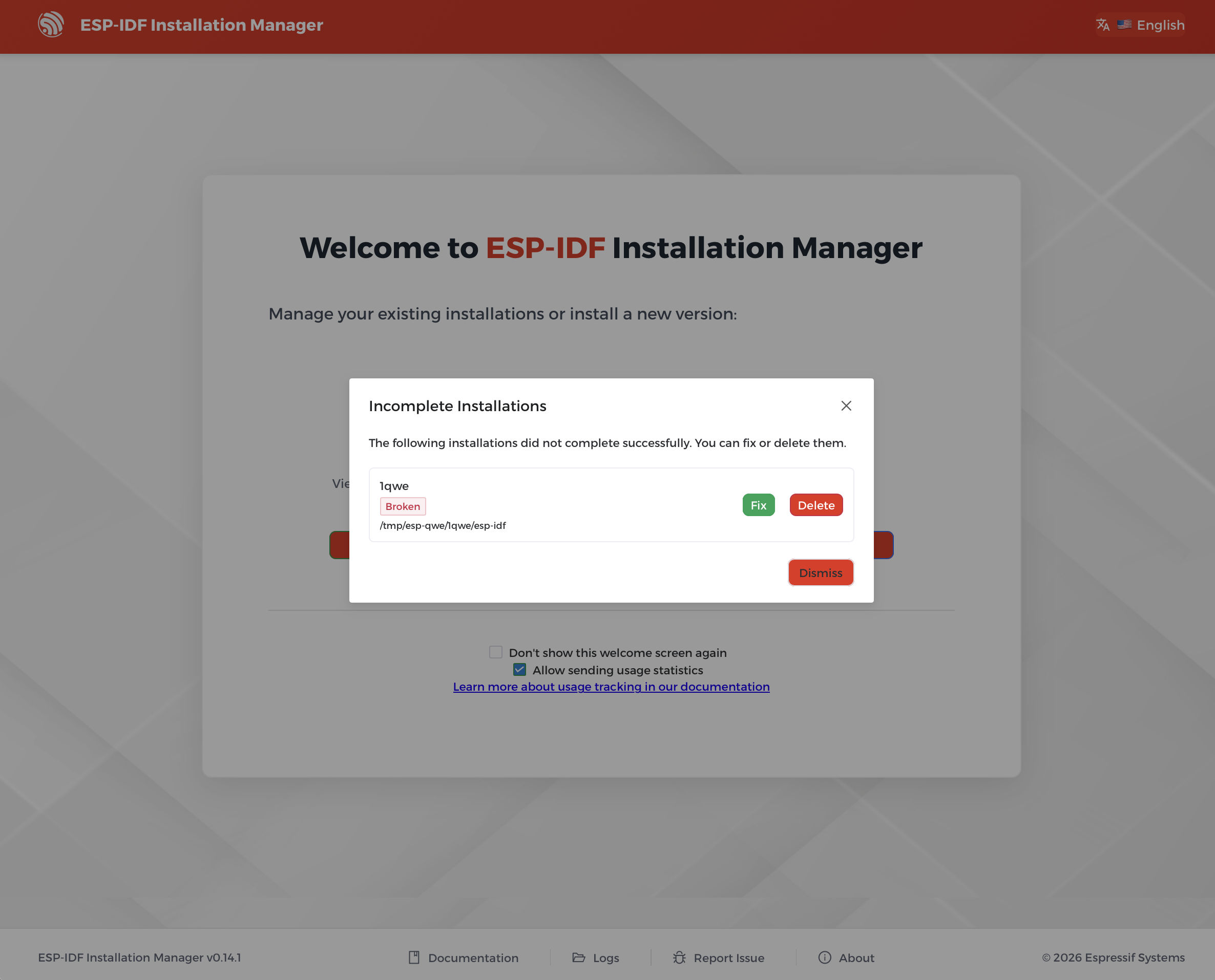
For each incomplete installation the modal shows its name, status tag, and path. You can:
- Fix — start a repair and be taken directly to the installation progress page to follow the process live.
- Delete — remove the incomplete installation entirely.
- Dismiss — close the modal and deal with the entries later from the Version Management dashboard.
This check runs only once per app start and is non-blocking — the rest of the application is fully usable while the modal is open.