ESP-WebRTC Real-Time Communication Solution
Introduction
ESP-WebRTC-Solution is Espressif’s WebRTC application development solution for ESP32 series SoCs. It includes core code such as the WebRTC orchestration layer esp_webrtc, the PeerConnection implementation esp_peer, and the audio/video playback component av_render, and provides a series of example applications under the solutions/ directory that can be directly compiled and flashed, covering scenarios such as voice assistants, video doorbells and calls, cloud streaming and SFU integration, and RTSP/RTMP bridging. See the README in each example’s own directory for hardware requirements and build steps.
Core Components
esp_webrtc: The WebRTC application orchestration layer, which combines signaling, PeerConnection, and the media system, exposing interfaces such asesp_webrtc_startandesp_webrtc_stop. Once the audio/video codec parameters are configured, connection establishment, capture and sending, and reception and rendering are all handled automatically internally.esp_peer: The concrete PeerConnection implementation. The code is enhanced based on the open-source project libpeer, supporting TURN (RFC 5766, RFC 8656), parallel probing of multiple candidate addresses, dual Controlling/Controlled roles, RTP NACK retransmission, and SCTP SACK and large-data fragment reassembly. Sending and receiving each run in independent tasks.Signaling abstraction: The three interfaces
start,send_msg, andstop, defined byesp_peer_signaling_impl_t, shield the differences between specific signaling protocols. Each solution connects to signaling implementations such as AppRTC-style WebSocket, WHIP, Amazon KVS, Janus, Kurento, or OpenAI Realtime as needed.esp_capture: Responsible for audio/video capture, published as an independent component in the ESP Component Registry.av_render: A push-style audio/video player. Audio and video are each processed in independent decoding threads, and after alignment by the synchronization module, are handed over to audio (I2S) and video (LCD, etc.) rendering output.
Technical Architecture
esp_webrtc organizes the connection establishment process into three layers: signaling, PeerConnection, and the media system. Signaling is responsible for discovering the peer and exchanging SDP and ICE information; PeerConnection is implemented by esp_peer, which collects candidate addresses based on ICE, completes hole punching, and establishes the connection; the media system sends the audio/video data captured by esp_capture through the PeerConnection, and passes the received media stream to av_render for playback. Users only need to configure the audio/video codec parameters, and the data transfer and state synchronization between the three layers are handled automatically by esp_webrtc. When a new signaling server needs to be adapted, only the esp_peer_signaling_impl_t interface needs to be implemented, and the PeerConnection and media system parts are unaffected.
In addition to the media stream, PeerConnection also supports an SCTP-based data channel, used for sending and receiving custom data that does not go through the audio/video codec path, such as the call control commands of videocall_demo and the chat text of peer_demo.
The overall timing of connection establishment is as follows:
        sequenceDiagram
    participant App as "Application"
    participant Webrtc as "esp_webrtc"
    participant Sig as "signaling"
    participant Peer as "esp_peer"

    App->>Webrtc: esp_webrtc_start
    Webrtc->>Sig: Start signaling connection
    Sig-->>Webrtc: Report ICE information
    Webrtc->>Peer: Open PeerConnection
    Sig-->>Webrtc: Notify signaling connected
    Webrtc->>Peer: Initiate new connection
    Peer-->>Webrtc: Report local SDP
    Webrtc->>Sig: Send SDP
    Sig-->>Webrtc: Forward peer SDP
    Webrtc->>Peer: Set remote SDP
    Peer-->>Webrtc: Connection established
The signaling connection, ICE negotiation, and SDP exchange are all chained together by esp_webrtc, and the application layer only needs to be aware of the two actions of starting and stopping.
Solution List
The solutions under the solutions/ directory of the repository are divided into the following four categories by purpose.
Learning and API Basics
peer_demo: A minimal example built from scratch using only the
esp_peerAPI. After connection establishment, it periodically sends and receives chat text through the data channel.
Cloud, Streaming, and SFU Integration
openai_demo: Based on the OpenAI Realtime WebRTC ephemeral token flow, it establishes a real-time voice session with the OpenAI Realtime service, supporting function calls triggered by voice commands.
whip_demo: Uses the WHIP protocol to push audio/video to the server.
kvs_master: Connects to Amazon Kinesis Video Streams signaling in the MASTER role, receiving the VIEWER’s SDP offer and answering it.
kms_demo: Acts as the streaming end for Kurento Media Server, allowing browsers to view the footage through KMS.
janus_demo: Connects to the VideoRoom plugin through Janus HTTP signaling, acting as the publishing end for streaming.
Productized Examples
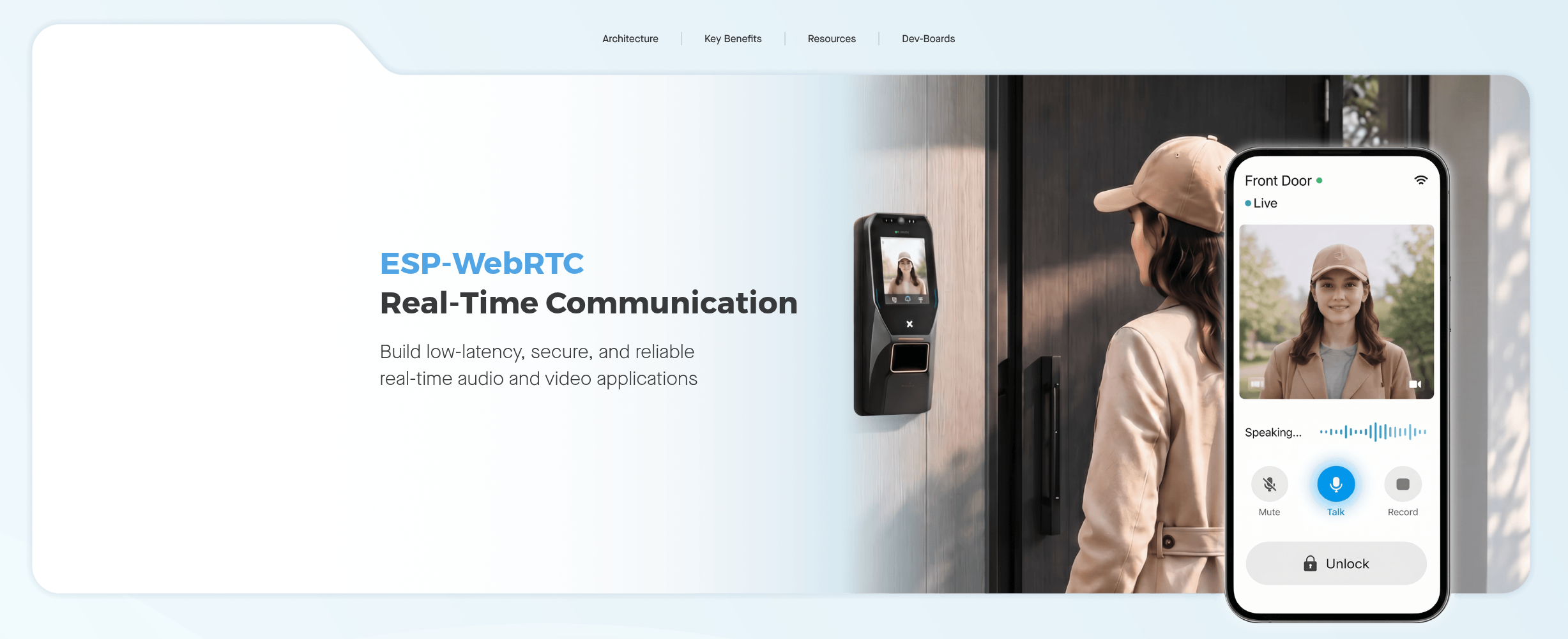
doorbell_demo: A doorbell application implemented with reference to the AppRTC signaling method, supporting remote control, real-time video, and two-way voice.
doorbell_local: A local doorbell solution in which the ESP device itself takes on the signaling service, and additionally integrates pedestrian detection capability.
videocall_demo: A device-to-device video call application implemented based on the data channel.
Bridging and RTSP/RTMP
webrtc_usb_camera: A WebRTC-to-USB UVC bridging solution. The browser sends media data through WebRTC, and the host recognizes the ESP device as a standard USB camera.
rtsp_demo: Starts an RTSP server or streaming end on the device side, used for media stream transmission within a local area network.
rtmp_demo: Captures audio/video from the device and pushes it to the server via RTMP.
Hardware Applicability
Video-based solutions (doorbell, video call, and streaming scenarios such as WHIP, KVS, KMS, and Janus) are by default verified based on the ESP32P4-Function-EV-Board, which comes with an SC2336 camera and meets the requirements for video capture and hardware codec. Solutions that only use audio and the data channel (such as peer_demo and openai_demo) have lower hardware requirements and can run on ordinary Wi-Fi-capable development boards; openai_demo is by default verified based on the ESP32-S3-Korvo-2, in order to obtain echo cancellation capability. Refer to the Hardware Requirements section of each solution’s README for the specific model.
References
Repository address: espressif/esp-webrtc-solution
See the README in each solution’s own directory for hardware wiring, configuration items, and build steps.