ESP8266
Note
This document is automatically translated using AI. Please excuse any detailed errors. The official English version is still in progress.
ESP8266/ESP8285 Chip/Module Startup Conditions
The operating voltage range for the ESP8266/ESP8285 chip is
2.5 V ~ 3.6 V; when using a single power supply, it is recommended that the power supply voltage is3.3 V, and the output current needs to reach500 mAor more.The operating voltage range for the ESP8266/ESP8285 module is
2.7 V ~ 3.6 V; when using a single power supply, it is recommended that the power supply voltage is3.3 V, and the output current needs to reach500 mAor more.The CHIP_PU(EN) pin of ESP8266/ESP8285 is the chip’s boot pin. When CHIP_PU(EN) is at a high level, the chip is enabled; when it is at a low level, the chip is turned off. Note: The CHIP_PU(EN) pin should not be left floating. When ESP8266/ESP8285 is powered by a 3.3V system power supply, the CHIP_PU(EN) pin must be at a high level.
Hardware Connection
The ESP8266 defaults to downloading firmware via UART0 (i.e., TX0 (GPIO1) and RXD (GPIO3)).
When downloading firmware based on the ESP8266/ESP8285 module, users need to prepare:
3.3V Power Supply
Serial Debugging Tool
Dupont wire
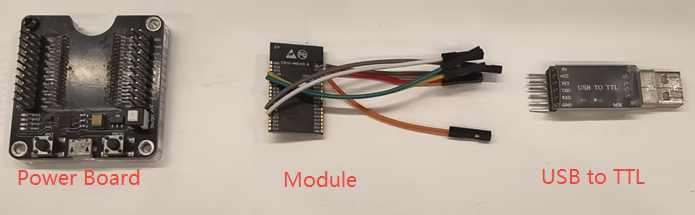
Proceed with the wiring as follows to meet the hardware requirements for chip power supply, power-on startup, and entering download mode.
ESP8266/ESP8285 |
3.3V External Power Supply |
Serial debugging tool |
|---|---|---|
3V3 |
VDD |
|
GND |
GND |
GND |
EN |
VDD |
|
GPIO0 (Pull down, default Pull up) |
GND |
|
GPIO15 (pull-down, default pull-down) |
GND |
|
TXD0(GPIO1) |
RXD |
|
RXD0(GPIO3) |
TXD |
When testing with the ESP8266 Development Board, connect a USB Type-C cable to the board; the on-board USB-UART bridge connects to chip UART0 for firmware download. You can also hold the Boot button and then power on (pull down GPIO0) to enter download mode manually.
Chip Power-On Startup Log
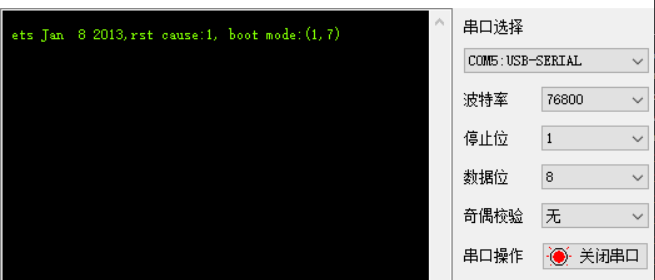
After powering on the ESP8266/ESP8285 chip/module, you can use the PC-side serial debugging software (such as XCOM) to view the UART0 serial output during chip power-up to confirm whether the chip has entered download mode. If the chip powers up and enters download mode, UART0 will print the following log:
ets Jan 8 2013,rst cause:1, boot mode:(1,7)
Note
After powering up the ESP8266 chip/module, if you do not see the log printing, you can trigger the log printing by pulling down and then pulling up the CHIP_PU (EN) pin for a hardware reset.
In addition, you can get the Strapping pins level state at power-on from the chip power-on startup log. For detailed instructions, please refer to ESP8266 Boot Log instructions.
As described above, the development board downloads firmware through the on-board USB-UART bridge to chip UART0; if the chip does not enter download mode automatically, hold the Boot button and then power on (pull down GPIO0).
In terms of software, Espressif provides a PC-based Flash download tool, which can directly download firmware (.bin) into Flash. For usage instructions, refer to the Flash Download Tool User Guide.
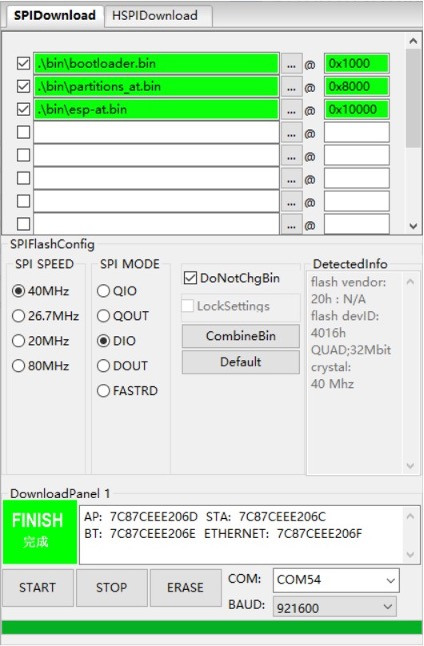
After the firmware download is complete, if you want to run the burned firmware, you can pull up GPIO0 (default pull-up) based on the aforementioned hardware wiring, and then pull down and pull up the CHIP_PU (EN) pin for a hardware reset restart, allowing the chip to re-enter the Flash boot mode. Finally, use the serial debugging software to view the UART0 log printout to check the firmware running status.
Reference
Hardware wiring principle summary:
Official Documentation: