Device Core host SDK
@esp-vision/device-core is the UI-independent JavaScript host SDK for ESP-VISION EV-MUX v4 firmware. IDE, the Device CLI and custom host applications share its byte framing, ownership, keepalive, Python, files and image handling. Agent workflows use the CLI for device control; the official Knowledge MCP provides documentation over HTTP. SDK source is maintained in host/device-core.
- Application API reference
- Creation and byte transport
- device.discover(options)
- device.connect(options)
- device.disconnect()
- device.inspect(request)
- device.configure(request)
- device.control(request)
- device.python.input(data)
- device.python.execute(request)
- Device file operations
- device.capture(request)
- device.on(event, handler)
- Concurrency, cancellation and errors
- Firmware checks and updates
- Selecting a firmware version
- Immutable release snapshots and single-BIN updates (0.4.0)
- Advanced export API reference
- @esp-vision/device-core
- @esp-vision/device-core/evmux
- @esp-vision/device-core/evrepl
- @esp-vision/device-core/session
- @esp-vision/device-core/actions
- @esp-vision/device-core/bindings
- @esp-vision/device-core/firmware
- @esp-vision/device-core/node
- @esp-vision/device-core/discovery
- @esp-vision/device-core/discovery/node
- Integration boundaries
- FirmwareFlashSession.flash result
- @esp-vision/device-core/browser
- Release readers in @esp-vision/device-core/firmware (0.5.1)
- Browser flash startup
- Integrating the Device Core npm Package
- Source, versions and installation
- Application, Core and transport responsibilities
- Standalone Node TCP example
- Browser Web Serial example
- Files and interactive Python
- Wi-Fi configuration and status
- Discovery and identity checks
- Preview, logs and capture
- Reset, flashing and publication
- Firmware update application entry
- Browser ROM flashing
- Device management CLI
Installation and compatibility
npm install '@esp-vision/device-core@~0.6.0'
# Optional Node LAN discovery adapter:
npm install multicast-dns
These examples target SDK 0.6.0; declare a minor-locked range, record the resolved patch in a lockfile, and verify registry availability before installation. Node.js 22 is the host baseline. Browsers require a bundler/import map and a host-provided Web Serial or binary WebSocket transport. Only EV-MUX v4 is supported; a v3 device must update firmware. Package, firmware and IDE versions are independent. Source 0.6.0 is a minor release after 0.5.1; source changes and dry runs do not establish npm availability or update the Core bytes embedded in existing CLI/Plugin releases. Camera observation requires firmware feature debug.capture_frame.observed.v1 and rejects older unsafe implementations locally.
Architecture and starting point
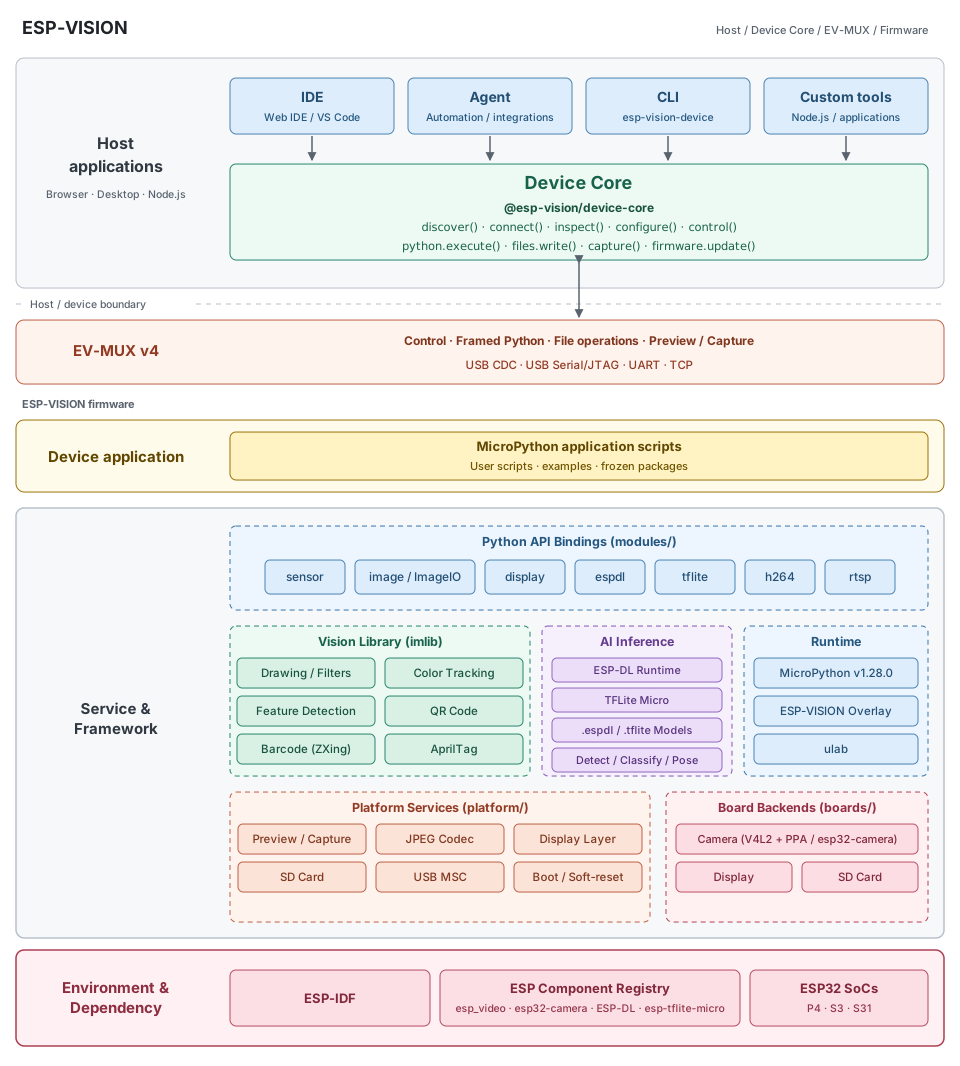
IDE / Device CLI / custom host apps → Device Core → EV-MUX → firmware; Knowledge MCP → documentation over HTTP
The same SVG is used by the project README and system architecture chapter. Host applications select devices and provide UI/workflow policy; Device Core owns the shared API, protocol and session state; EV-MUX defines runtime communication with the firmware. Byte adapters supply serial/socket I/O without parsing another protocol stack. Representative APIs in the figure do not replace the full API reference. Discovery and ROM flashing have separate lifecycles; the ROM loader does not carry image writes through EV-MUX.
The root exports only createDevice. It returns a device object; there is no public Device constructor. Use Application API reference for every application method, option, result and event. Advanced export API reference inventories all other package exports and their public class methods for integration maintainers. Agent workflows use the Device CLI for device operations; Knowledge MCP is a separate documentation interface.
import { createDevice } from '@esp-vision/device-core'

// transport is supplied by the host; its complete contract is in api.
const device = createDevice({ transport })
const off = device.on('python.output', text => console.log(text))
try {
  await device.connect({ role: 'usb' })
  console.log(await device.python.execute({ source: 'print(1 + 2)' }))
} finally {
  try { await device.disconnect() } finally { off() }
}
For complete runnable Node TCP and browser Web Serial adapters, see Integrating the Device Core npm Package. For packet layouts, routing and ownership, see index; hardware verification uses the shared entry point described in validation.
Licensing
The npm package and ESP-VISION contributions follow Apache-2.0, matching the firmware. The package includes LICENSE and NOTICE; NOTICE preserves historical MIT copyrights and permission text. Third-party dependencies retain their own licenses. See Licensing for the project inventory.
SDK 0.5.1 includes Node transports, serial/network inventory, ROM flashing, immutable release snapshots and single-BIN application updates. The @esp-vision/device-core/node entry exports these host adapters and bundler asset URLs. Installed checks: npm --prefix node_modules/@esp-vision/device-core test and npm --prefix node_modules/@esp-vision/device-core run test:hardware -- --help. A missing or empty suite fails. See Integrating the Device Core npm Package for application discover() versus provider list().