Solution Architecture
ESP-VISION separates host tools, online knowledge and device firmware. IDE and custom SDK applications use Device Core directly. AI clients and independent agents use the plugin Skill, its bundled Device CLI for local device operations, and the official online Knowledge MCP over HTTPS. Device CLI calls Device Core; the SDK implements the host side of EV-MUX v4 over board-supported USB CDC, USB Serial/JTAG, UART or TCP. Device firmware combines MicroPython, vision/inference modules, platform services and board backends. Firmware code is further layered by whether it touches MicroPython (mp_obj_t / py/*.h).
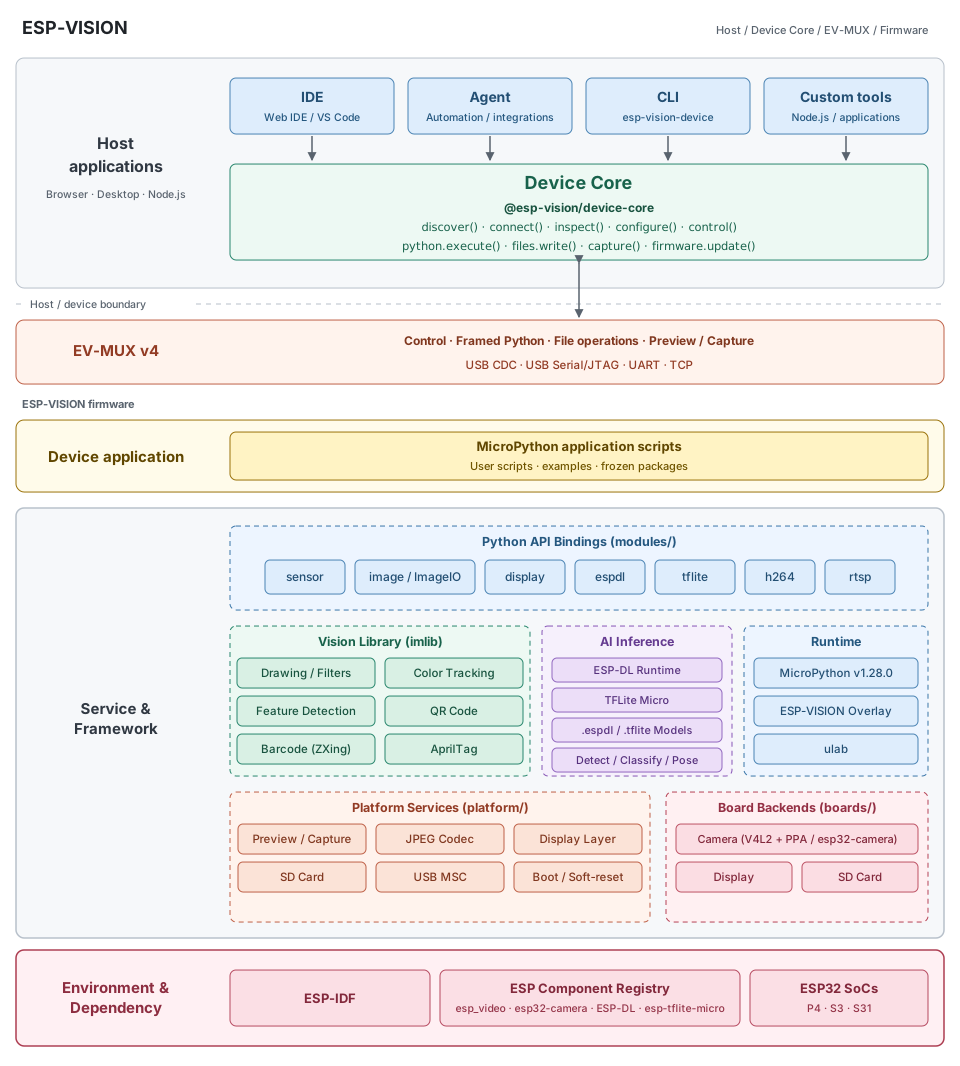
Local device control through Device CLI / Device Core, with a separate online Knowledge MCP service
Layered Overview
Host applications: IDE presents editing/debugging UI; custom applications use the SDK; AI clients and independent agents select tools for the task. Agents own their AI loop.
Plugin (
host/esp-vision-plugin,@esp-vision/plugin): packages one capability-oriented Skill, a fixed Device CLI and the official Knowledge HTTP endpoint configuration for Codex, Claude Code and WorkBuddy.Device CLI (
host/device-cli,@esp-vision/device-cli): exposes device operations through shell commands, JSON results, streamed events and binary output files. Both the plugin copy and the standalone command use public Device Core APIs.Knowledge MCP (
host/knowledge-mcp,@esp-vision/knowledge-mcp): provides API, documentation and example queries from a versioned snapshot. The official plugin connects to the online HTTP service; the npm package supports stdio and HTTP for self-hosting. Main builds the snapshot, npm archive and immutable image; website deploys that image. HTTP records anonymous daily aggregates.Device Core (
host/device-core): the independently versioned@esp-vision/device-corenpm package owns protocol parsing, request correlation, sessions, keepalive and operation lifecycles. The diagram selects representative API names instead of listing every method; complete contracts are in Application API reference.EV-MUX v4: the runtime wire protocol between Core and firmware, covering framing, logical channels, ownership and VM epochs across USB CDC, USJ, UART and TCP. Host adapters and network bridges carry bytes without creating another session owner.
Device application: MicroPython scripts run on the board and call its Python bindings. They can continue running after a host disconnects.
Bindings (
modules/): theUSER_C_MODULESlayer. The main modulesimage,sensor,display,espdl, andtfliteself-register viaMP_REGISTER_MODULE.py_imageio.cprovides theimage.ImageIOtype, andpy_helper.cis shared helper code. Bindings only do object conversion and light API adaptation; heavy logic lives in pure C orplatform/.Platform services (
platform/): self-written ESP32 glue.ev_channel.c/ev_mux.c/ev_control_transport.c/ev_stdio.c(EV-MUX / EV-ATP transport),preview.c(EV-MUX JPEG preview),display.c(generic display layer),sdcard.c(mount at/sdcard),usb_msc.c(exposes theffatpartition over TinyUSB MSC),usb_auto_download.c(S3/P4 OTG CDC reset/download protocol),jpeg.c(hardware or software JPEG),debug.c, andmain.c(startup init plus the soft-reset loop).imlib component (
components/imlib/): pure-C vision algorithms, an IDF component maintained as MIT, derived from OpenMVlib/imlib.Board backends (
boards/<BOARD>/): per-board configuration and the real camera/display/sdcard implementations. P4X and S31 useesp_video/V4L2; P4X also uses PPA, while S3 usesesp32-camera.MicroPython + overlay: MicroPython v1.28.0 is the fixed baseline; project changes live in
overlay/micropython/and are applied to a generated build copy underbuild/micropython/.
Host-provided byte transports implement physical I/O beneath the SDK protocol. LAN DNS-SD discovery is an enumeration path before connection; ROM firmware flashing uses a separate loader lifecycle and does not send application images through EV-MUX. Firmware and SDK versions remain independent. See Device Core host SDK for host integration and API documentation.
Capture-to-Output Data Flow
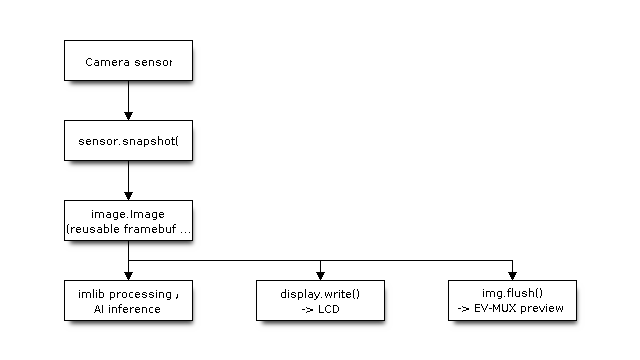
sensor.snapshot() captures a frame into a reusable framebuffer wrapped as an image.Image. Scripts then run imlib processing, ESP-DL inference, or TFLite Micro inference on the image, and send it to the LCD with display.write() or to the host preview with img.flush().
Communication Subsystem
EV-MUX v4 owns user/debug streams together and multiplexes channels onto the current USJ, USB, UART or TCP owner link. MicroPython HAL, C stdio, IDF logs and JPEG preview have distinct producer paths.
Detailed architecture, interfaces, acquisition, framing, Python/files/images and acceptance are in Communication System and EV-MUX. The current Python traceback/sys.stderr path is documented in Architecture, Execution Contexts and Standard I/O. This keeps one canonical communication chapter rather than duplicating it in architecture and Agent guides.
Source Tree
Path |
Responsibility |
|---|---|
|
Public host SDK and transport adapters ( |
|
Standalone device command toolkit ( |
|
Knowledge MCP runtime, packaged snapshot and server image ( |
|
Skill, bundled CLI, Knowledge endpoint configuration and installer ( |
|
Board-aware |
|
Integration hub: registers user modules, platform and board sources, include paths, conditional |
|
Pinned third-party submodules (MicroPython, |
|
ESP-VISION MicroPython delta, using the MicroPython path layout. |
|
Per-board config, frozen manifests, and board peripheral backends. |
|
Shared runtime services (camera, preview, storage, display, USB, JPEG). |
|
MicroPython C/C++ bindings ( |
|
ESP-IDF components, including OpenMV |
|
Optional model assets loaded from board storage at runtime. |
|
MicroPython example scripts. |
|
|
Board Composition
A board is defined in a single tree, boards/<BOARD>/:
ESP-VISION side (top level):
boardconfig.h,imlib_config.h,manifest.py, and optionalcamera.c/display.c/sdcard.c.MicroPython port side (
boards/<BOARD>/port/):IDF_TARGETvalue, sdkconfig, partitions, and USB strings. The build projects this subdirectory ontoports/esp32/boards/<BOARD>/of the generated MicroPython copy.
See Add a New Board for the step-by-step procedure.
Chip-Dependent Sources
micropython.cmake selects modules from IDF_TARGET and the board profile. The ESP32-P4 build includes h264 and rtsp; the current P4 board profiles also enable the ZXing-C++ barcode backend. See Chip and Board Support for the resulting public API matrix.
MicroPython Overlay
ESP-VISION uses MicroPython v1.28.0 as a fixed upstream baseline. Project changes to the ESP32 port live under overlay/micropython/. The prepare-micropython build step applies that tree to a generated copy under build/micropython/idf<ESP_IDF_VERSION>/micropython/; the lib/micropython submodule remains a clean upstream reference.
For how ESP-VISION relates to its upstream projects, see Project Relationships; for the license of each component, see Licensing.
The same Device Core firmware API supports two explicit ROM operations: default application-only update with layout matching, and complete installation for blank devices using bootloader/partition/application manifests. Neither operation uses EV-MUX for firmware payloads; IDE/Agent/CLI share its validation and readback logic rather than implementing separate flashing workflows.