Session ownership, acquisition and recovery
What takeover means in v4
All supported physical interfaces can compete for acquisition, but only the first valid request accepted by the device becomes owner. Later requests cannot force out a valid owner. Default ports, DTR, USB insertion order and debug streams do not establish priority.
route.bind and route.auto are no longer public operations and return UNSUPPORTED_OPERATION. Both user/debug streams transfer with the sole owner. For host B to take over, A must release, or its link/lease must expire, before B acquires.
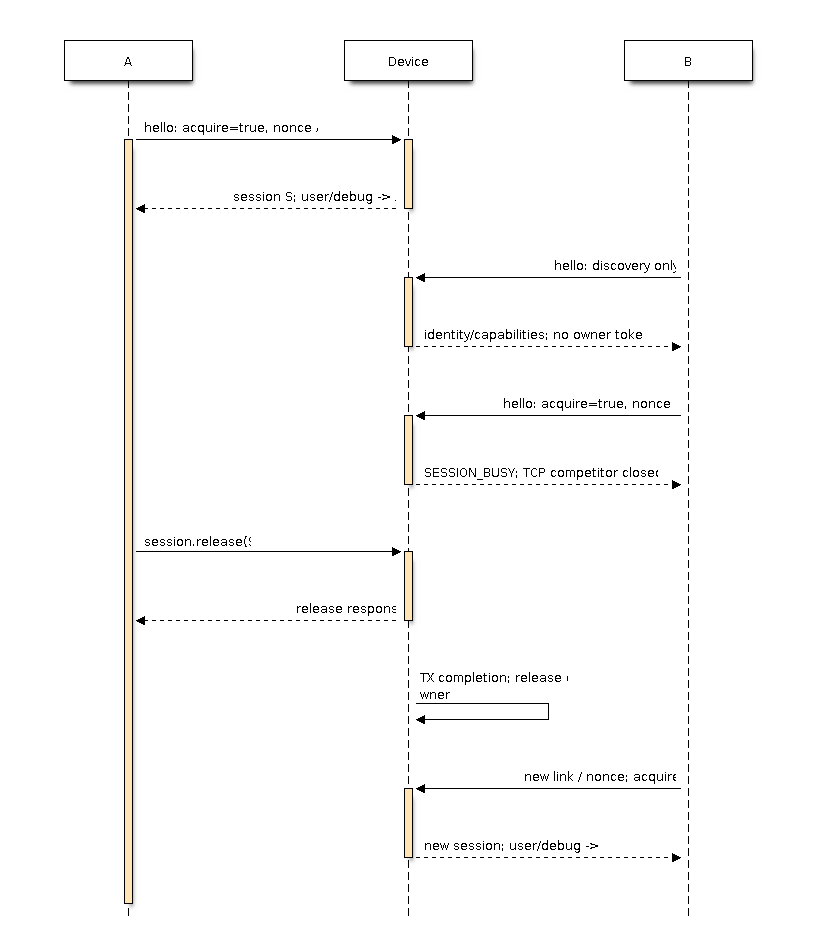
Figure 9: Discovery, failed competition and explicit handoff. Discovery does not authorize B to send Python/file commands, and A cannot transfer its token to B.
Session state machine
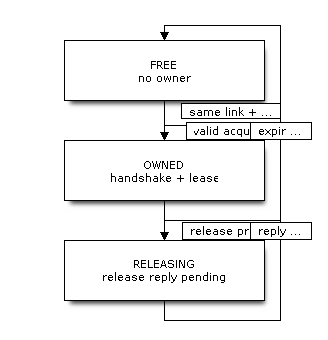
Figure 10: Release preparation and completion preserve the link until its reply is sent. Immediate reacquisition after receiving release may briefly return SESSION_RELEASING. On the same link, retry the same hello nonce within a bounded total deadline; never retry indefinitely.
Initial discovery and acquisition
Drain startup residue after opening serial; TCP acquires directly. Metadata and payload in the following block are two parts of one frame, not separate JSON frames:
{"seq":1,"channel":"user.rpc","type":"req","method":"hello","encoding":"json"}

{"evMuxVersion":4,"acquire":true,"clientNonce":"0123456789abcdef0123456789abcdef"}
Successful payload example with additional capability fields omitted:
{
  "ok": true,
  "evMuxVersion": 4,
  "session": {
    "id": "89abcdef0123456789abcdef01234567",
    "owner": "tcp",
    "leaseMs": 15000,
    "keepaliveMs": 5000,
    "vmEpoch": 1
  },
  "vmReady": true,
  "routes": {"user": "tcp", "debug": "tcp"}
}
Match rsp/hello by seq, channel and method before accepting the new token. Empty hello/capabilities only discover the device. Discovery replies return to the exact ingress link and do not disclose the valid owner ID to contenders.
clientNonce is a 32-character lowercase hexadecimal identifier for one logical acquisition. Reuse it only when retrying that acquisition on the same link; generate a new value for a new socket, reopened serial port or new acquisition. Same-link, same-nonce idempotent hello can return the same valid session, not transparently replay arbitrary operations.
Handshake completion is gated on acquisition-reply TX completion. Generating a sessionId internally does not authorize the host to submit dependent operations before receiving a valid reply.
Keepalive is not application completion
{"seq":2,"channel":"user.rpc","type":"req","method":"session.keepalive","encoding":"json","sessionId":"89abcdef0123456789abcdef01234567"}

{}
Default keepalive is 5000 ms and lease 15000 ms; authorized application activity also renews the lease. Schedule according to reported values and keep reading/renewing throughout long scripts, file transfers and preview. Do not wait for an operation to finish before renewing.
Successful keepalive confirms current link/session validity and can report VM generation/readiness. It does not prove script completion, fully published files or applied network configuration.
Four identity/correlation dimensions
Dimension |
Purpose |
What it cannot imply |
|---|---|---|
link generation |
Reject work left over from an old physical connection. |
The same port name or TCP slot need not represent the same connection. |
|
Authorize the exact link owning the current session. |
Cannot transfer from discovery replies, another host or an old socket. |
|
Identify generations of VM operations and output. |
Advancing generation does not imply an idle/executable VM or REPL. |
|
Correlate a response within one request context. |
An event, preview or old response with the same seq cannot complete this RPC. |
All non-discovery operations carry sessionId. VM-scoped file.write/script.write/script.run, camera/object/VFS debugging and repl.stdin/repl.signal also carry current vmEpoch. Transport statistics, keepalive, release and background network controls do not require an idle VM, but still require appropriate owner authorization.
Startup VM readiness and soft reset
Current initial vmEpoch is a random nonzero uint32; older v4 builds may report 0 during startup. Transport controls retain the returned value; VM operations wait for a positive epoch and vmReady:true. Nonzero sequence numbers wrap from 4294967295 to 1. Compare using wrap-aware ordering rather than simple numerical greater-than.
Soft reset may preserve sessionId and networking; epoch advances at reset start. event/hello is supplemental, not sufficient proof. Confirm the new epoch/readiness through a correlated keepalive, then perform a current-generation REPL barrier requiring an actual new marker.
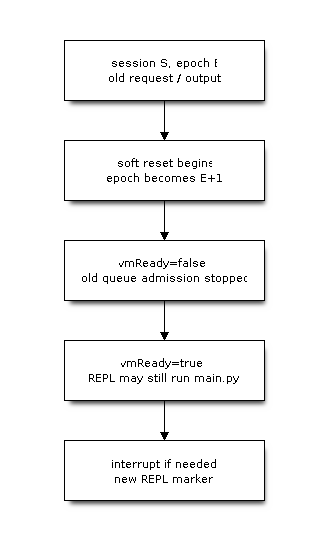
Figure 11: Transport liveness, VM readiness and executable REPL are separate conditions. Restarted boot.py/main.py may still occupy REPL; readiness alone does not permit immediate VFS/camera VM RPCs.
Hard reset/ROM entry invalidates old tokens, epochs, pending requests and decoder state. Rediscover/acquire after runtime returns. Soft reset clears old VM output parsing state; it must not arbitrarily discard an in-progress physical EV-MUX frame buffer.
Disconnects, FIN/RST and silent disappearance
TCP FIN/RST or confirmed invalid link: reclaim its owner and invalidate old-generation output; create a new connection and nonce before acquisition.
Actual USB disconnection invalidates the link. Closing a host serial handle or changing DTR alone may not notify firmware; release explicitly.
Silent USJ/UART disappearance: wait for lease reclamation. Port type and default/fallback status do not grant early acquisition rights.
A formerly owned TCP link may retain a 30-second idle window before slot reclamation; this differs from the 15-second lease.
Lease release neither reverses completed external side effects nor guarantees the previous program stopped. After acquisition, B should confirm VM state, interrupt explicitly when necessary, and verify executable REPL with a new marker.
Errors and recovery decisions
Error |
Host response |
|---|---|
|
Another valid owner exists; request release/wait rather than forcing takeover or reusing its token. |
|
Same-link release completion is pending; retry the same nonce only within bounded acquisition. |
|
Stop old-session operations, discard local session state and establish a new session. |
|
The original VM request is invalid; reconfirm generation and do not automatically replay scripts/file writes. |
|
VM work cannot queue or was not serviced in time; resolve running scripts, cancellation/reset and actual REPL liveness. |
Link TX failure / host timeout |
Side effects may already exist. Mark completion unknown and query/verify file or transaction state first. |
Network transactions with the same operationId have dedicated correlation/recovery semantics. seq is not a universal idempotency key. Scripts, REPL input and file append have no general transparent-replay contract.