Architecture, Execution Contexts and Standard I/O
System architecture and responsibilities
IDE, Agent, CLI and custom tools are peer host applications using the same Device Core package. Core implements host APIs and protocol/session state; EV-MUX is the runtime wire protocol across USB CDC, USJ, UART and TCP; the firmware implements device operations and the MicroPython runtime. The representative API names shown below are an overview, not a complete inventory.
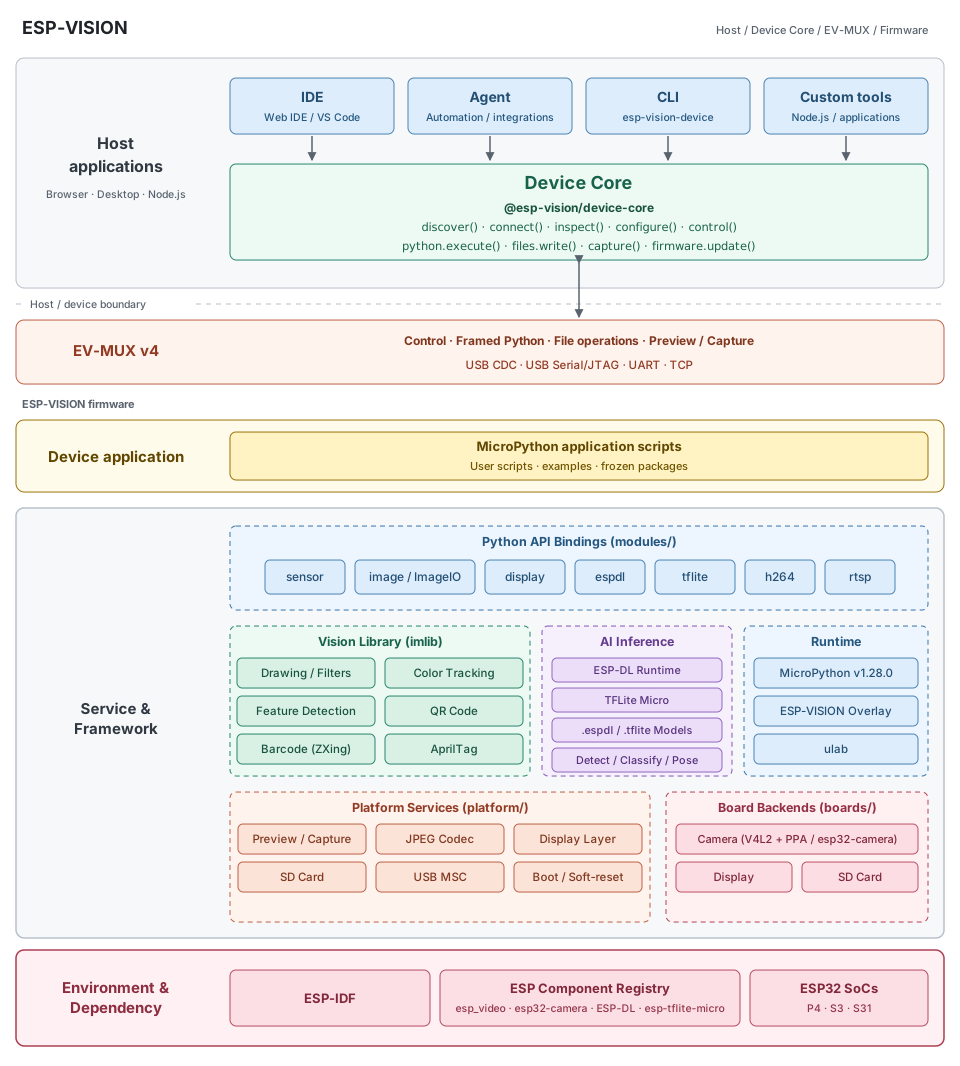
Shared system diagram; detailed firmware execution paths follow below.
This SVG is shared with the README, system architecture and SDK guides. Discovery and ROM flashing are separate from the EV-MUX runtime path; see Solution Architecture for those boundaries. Device scripts execute on the board and do not require a host to remain connected.
Where EV-MUX sits
EV-MUX is runtime byte framing and multiplexing. It neither executes Python nor replaces the existing VM. MicroPython retains parsing, compilation, execution, friendly REPL, stdin/stdout and exception printing; ESP-VISION attaches framing and ownership routing at HAL/platform boundaries.
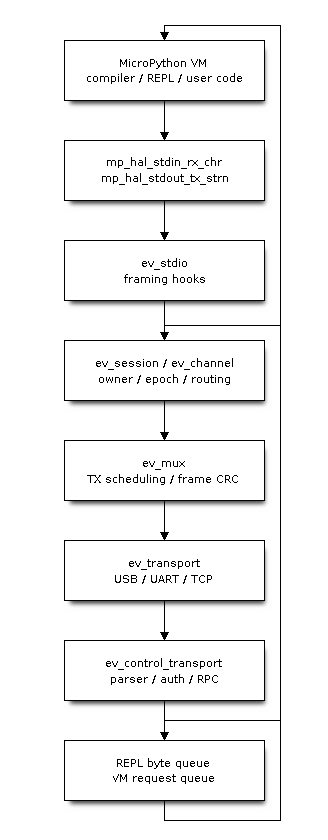
Figure 2: Interpreter, HAL, control, ownership/routing and physical backends. stdin/stdout still use the VM; pure transport RPC does not wait for user Python to return.
Output producer, not text content, determines the channel
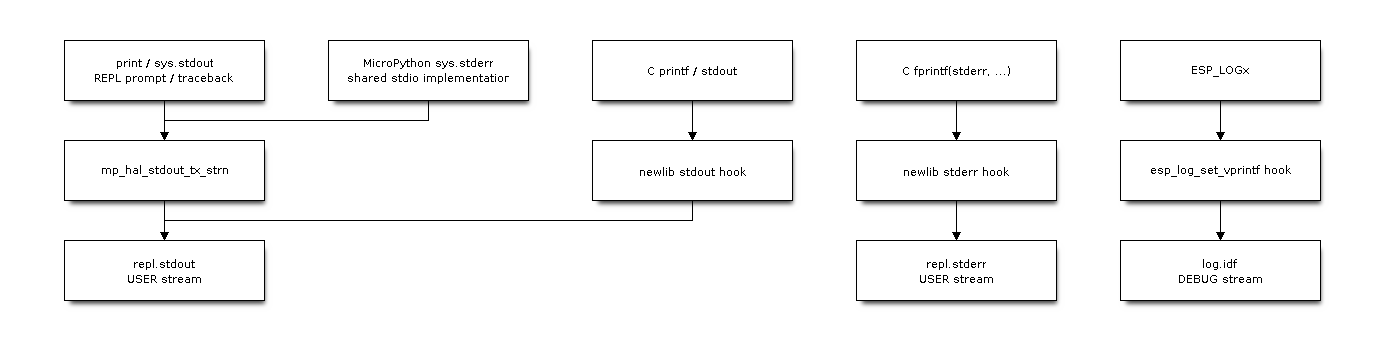
Figure 3: Actual output destinations in this build. Python print() and C printf() may share a channel but have different call paths. An “error” word does not automatically redirect text to repl.stderr.
Producer |
Firmware entry point |
Wire output |
|---|---|---|
Python |
MicroPython print/stdio → |
|
Unhandled REPL exceptions and |
|
Can appear on |
Current MicroPython |
|
Still |
C |
|
|
C |
newlib |
|
Normal ESP-IDF |
|
|
Platform logs such as |
Platform logging calls the EV-MUX IDF-log writer. |
|
|
Preview producer → JPEG encoder → lossy EV-MUX TX. |
|
encoding:text does not imply UTF-8 character or line boundaries at frame ends. Keep an incremental decoder and unfinished-line buffer rather than decoding each payload independently and accepting replacement characters.
Note
This table describes current source. Channel names do not imply language-level stderr behavior. A future dedicated Python stderr HAL path must update the table, clients and protocol tests.
IDF console versus MicroPython console
IDF system-console Kconfig selects low-level system destinations. MicroPython port settings enable UART REPL, USJ and TinyUSB CDC. EV-MUX ownership selects the runtime business link. These are three separate layers, not aliases of a single switch.
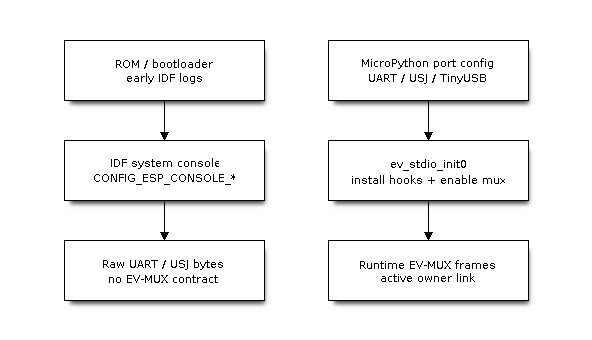
Figure 4: Early system console and runtime EV-MUX have different contracts. Power-on, ROM and panic paths can emit unframed text; runtime business confirmation still requires valid frames.
MICROPY_HW_ESP_USB_SERIAL_JTAG controls the ESP-VISION/MicroPython USJ path. Some target/version defaults may still send IDF console output to USJ when it is disabled. Enabled MicroPython USJ initialization explicitly enables peripheral clocks/internal PHY instead of relying on console initialization.
sensor.evmux(False) is a runtime diagnostic switch restoring non-framed text paths. ESP_VISION_EV_MUX_DEFAULT_ENABLED is local to ev_stdio.c and is not currently connected to boardconfig.h; defining it there does not disable power-on mux. Disabling framing is not v3 fallback negotiation.
Execution responsibilities
Context |
Work |
Relationship to user Python |
|---|---|---|
transport task |
Read links, frame/authorize ingress, handle discovery, lease/release, network transactions and pure-C transport stats. |
These controls remain serviceable during user execution; there is no second VM. |
VM task |
Friendly REPL, user code and VM RPC touching VFS/objects/camera. |
A long script can occupy this task. Queues are bounded; stop it before work requiring an available VM. |
TX task |
Deliver frames, handle partial writes/backpressure/priority and link loss. |
Producer data is copied or has a controlled lifetime, not a dangling VM temporary pointer. |
Network worker / TCP manager |
Wi-Fi setup, provisioning transactions, connectivity/listener maintenance and slot reclamation. |
Shares underlying Python WLAN; ordinary soft reset does not repeatedly initialize the driver. |
USB CDC callbacks / restart timer |
Record DTR/RTS and defer download/reset work. |
Do not tear down USB in its control callback; this is separate from EV-MUX acquire. |
file.write runs in the transport task and writes native VFS under session/VM generation and storage drain checks; it does not enter the interpreter queue. Legacy script.write, script.run, debug.capture_frame, debug.capture_screen and object-related debug.info enter the VM queue; scope:transport.stats is the exception. Two ring-array slots provide one usable pending request. Queue expiry is 5000 ms; busy/expired work reports VM_BUSY/VM_TIMEOUT.
LCD screenshots read the display layer’s last submitted RGB565 frame and encode JPEG in the same VM task. They do not invoke sensor or the camera, change displayed content, subscribe to preview or read back a physical panel. Execution is serialized with display/soft-reset cleanup to avoid reading freed frame buffers.
repl.signal Ctrl-C schedules KeyboardInterrupt when interpreter interrupts are armed; otherwise it enters REPL editing input. It is not FreeRTOS task preemption and cannot guarantee interruption of a non-returning native call.
Soft-reset and background communication lifetime
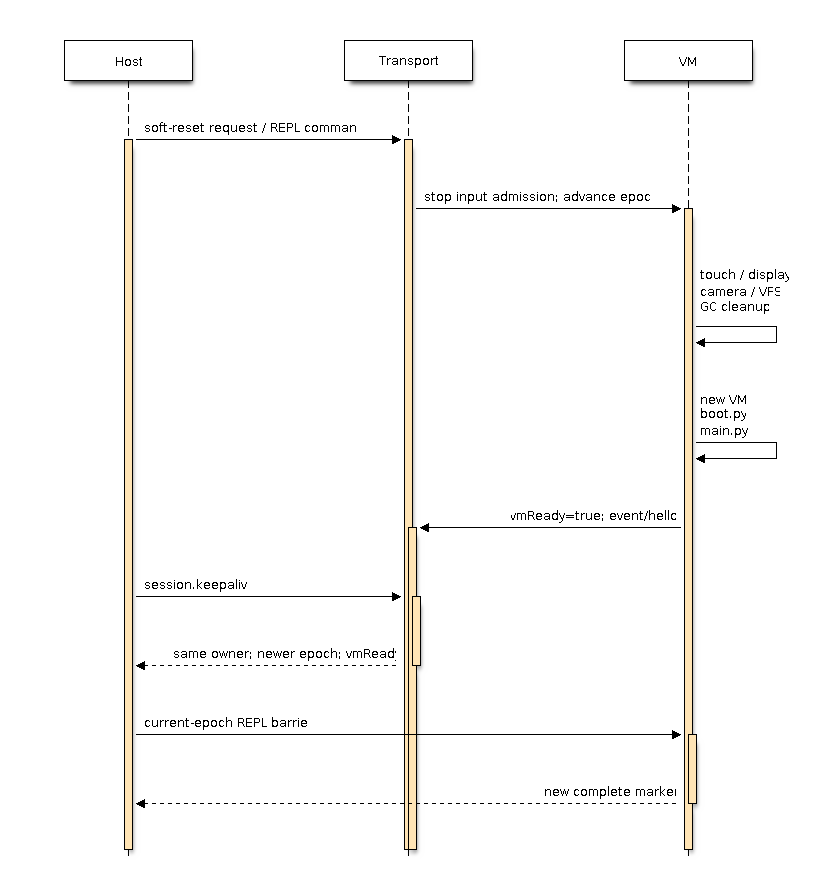
Figure 5: Soft reset advances VM generation while links/network/session can survive. Stop old admission before touch/display/preview/camera cleanup. Epoch advances at reset start, not VM readiness; wait for readiness and real REPL evidence.
Queues, logging failures and absence of raw fallback
Normal queues allow 16 KiB/8 frames per serial endpoint, with two TCP slots sharing a budget. Control reserves another 4 KiB/2 frames. REPL staging uses 512 bytes and an approximately 5 ms coalescing window; preview keeps the latest pending frame: see Preview, debug capture, backpressure and statistics.
While mux is enabled, submission/TX failure does not rebroadcast the same Python/C text through raw serial. Hooks guard recursion; error paths use counters instead of more traffic. IDF vprintf has a 512-byte temporary buffer and rejects oversized formatted output with a drop/error, rather than claiming complete delivery.
Early console, mux-disabled paths and low-level panic/ROM are different lifecycle boundaries, not send-failure fallback.
Source entry points
platform/ev_stdio.c and overlay/micropython/ports/esp32/mphalport.c adapt I/O; ev_control_transport.c dispatches ingress; ev_session.c/ev_channel.c manage ownership/routes; ev_mux.c manages framing/snapshots/queues/TX; ev_vm_output.c manages VM output scope; main.c manages startup/reset. Python stderr is implemented in lib/micropython/shared/runtime/sys_stdio_mphal.c.